The clearest way to answer what is a power catamaran is to start with what it is not. It is not a monohull with two propellers, and it is not a sailing catamaran with the mast removed as an afterthought — it is a hull form designed from the keel up around two narrow, low-drag hulls set wide apart, connected by a bridgedeck that carries the accommodation and, on most builds, a flybridge above. Each hull is slender enough to cut through water efficiently; the width between them, rather than the depth of a single hull, is what generates the interior volume.
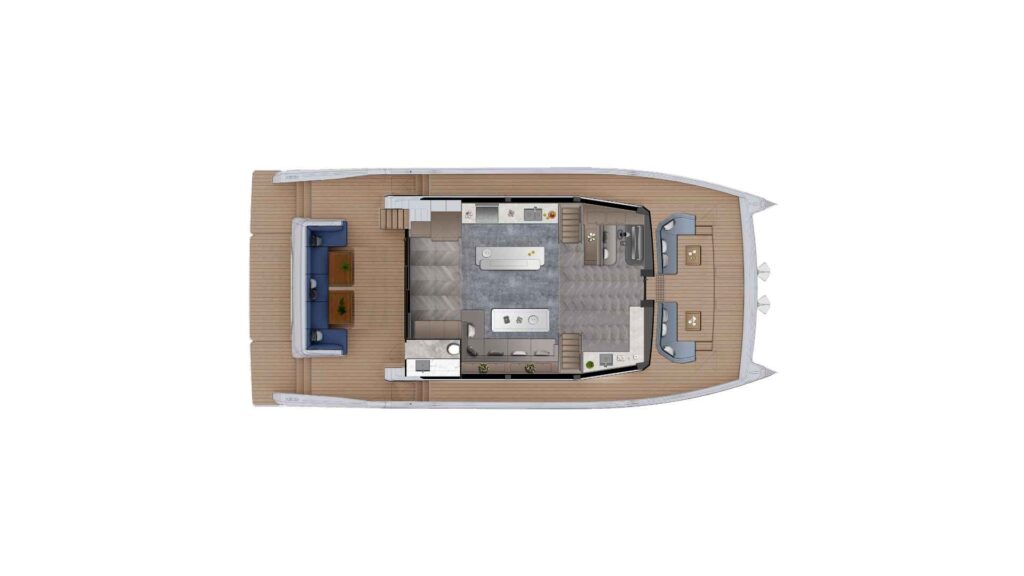
Because there is no rig to support, the structure above the bridgedeck answers only to the builder's imagination, not to mast-step loads or a boom's swing radius. On the OceanWalker S60 that freedom becomes four en-suite guest cabins plus two crew berths, 6'11" of headroom throughout, and a flybridge of more than 500 square feet doing duty as a genuine second living deck. Twin diesels — the S60 runs 2 × Volvo Penta D6-440s at 880 hp combined — sit one in each hull, driving independent shafts, which is also what makes the type famously easy to manoeuvre at low speed.
It is worth being specific about what is a power catamaran versus what simply looks like one: a monohull with a wide swim platform or a houseboat with twin outboards is not a power catamaran, because neither derives its stability and volume from two full-length, load-bearing hulls set at working beam. The defining test is structural, not stylistic — if the accommodation and structure genuinely span two hulls rather than sitting on one, the boat qualifies; if it doesn't, it's something else wearing a catamaran's silhouette.
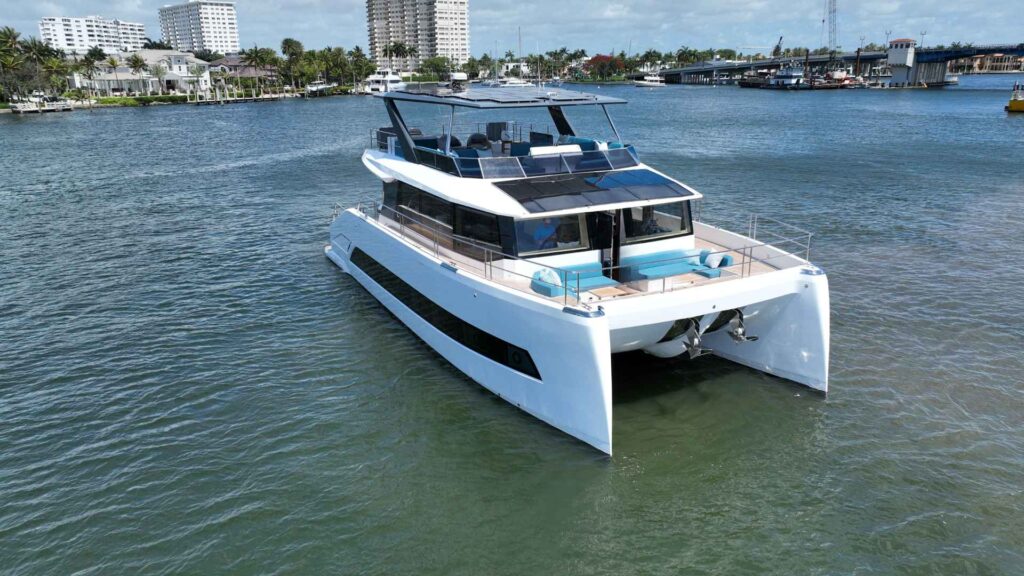
Ask what is a power catamaran's single biggest advantage over a monohull, and most owners answer in one word: space. Beam, not length, is what a catamaran sells, and the numbers make the point directly — the S60's 8.38 m beam is roughly 45% of its overall length, a ratio a monohull of the same length cannot approach without becoming unseaworthy. That width becomes a bridgedeck saloon with water views on three sides, a flybridge functioning as a genuine second deck rather than a sundeck afterthought, and cabins built into hulls wide enough for a proper double bed and en-suite head rather than a wedge-shaped berth.
The vertical dimension benefits too. With no rig loads to carry, the coachroof and saloon can be taller and more heavily glazed than a design built around a mast step and boom — which is why a power catamaran of a given length routinely out-volumes a sailing catamaran of the same length, let alone a monohull. Buyers often describe a 60-foot power catamaran as living like an 80-foot monohull, and the beam-driven arithmetic above is exactly why. Framed simply, what is a power catamaran's space advantage comes down to: beam sold as living area, not just as a stability number on a spec sheet.
Prices vary widely by builder and length, but a real, published example grounds the range better than an industry average. The table below sets out the OceanWalker S60's specification — the only figures here that are not builder-published are marked as typical for the class.
| Specification | OceanWalker S60 |
|---|---|
| LOA / beam | 18.87 m (60 ft) / 8.38 m (27'6") |
| Guest accommodation | 4 en-suite cabins + 2 crew berths |
| Headroom / flybridge | 6'11" / 500+ sq ft |
| Propulsion | 2 × Volvo Penta D6-440 diesel (880 hp) |
| Top speed / range | 18 knots / ~1,500 nm |
| Solar / generator | 22 panels, 9 kW / 32 kW |
| Price | €3.2M, all options included |
| Availability | Available now — Mediterranean demonstrator |
Related models scale the same design up or down: the larger OceanWalker X62 and the more compact OceanWalker X53 apply the same twin-hull, no-rig logic at different lengths, so the space and stability arguments above hold across the range. See the full specification page for every model side by side.
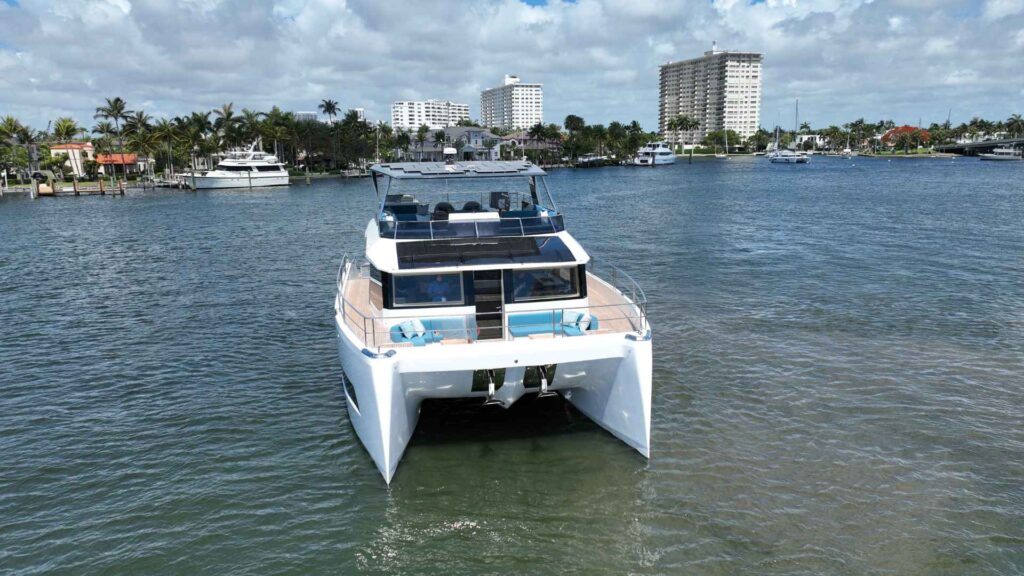
A power catamaran suits an owner whose real cruising pattern is coastal and social: short hops between anchorages, guests aboard who are not experienced sailors, a flybridge used as often as the saloon, and a schedule that answers to a calendar rather than the wind. It particularly rewards owners who want to run the boat themselves — the twin-throttle handling that makes docking easy shorthanded also removes the need for crew experienced in sail trim.
It suits less well an owner whose plan genuinely includes long, wind-powered ocean passages, where a sailing catamaran's fuel-free range under sail is the point rather than a compromise. If you are weighing what is a power catamaran best used for against your own cruising ground, the honest exercise is simply totting up last season's actual hops rather than the passages you picture in the abstract. For most Mediterranean and coastal owners, though, the honest answer to what is a power catamaran is: the boat built for the way they were already going to use it. See the Multihulls World archive for independent coverage of how the category has grown, and if you want to see one in person, the annual Cannes Yachting Festival Guide is the single best place to walk several side by side.