Strip away the romance and the power catamaran vs sailing catamaran question is really a question about your logbook. Not the passages you imagine, but the ones you will actually make. Mediterranean cruising, for most owners, is a sequence of two-to-five-hour hops between anchorages and marinas, often in light morning air or an afternoon sea breeze that arrives after you wanted to leave. Sailing that pattern well takes patience; motoring it takes a throttle.
This is why so many owners of large sailing cats admit — usually after the second season — that the engines do most of the work. The rig still has to be tuned, serviced, insured and surveyed whether it drives the boat or not. Standing rigging has a finite life; sails age in UV even when furled. If your season genuinely includes long trade-wind legs or you simply love the act of sailing, none of that is wasted. If it doesn't, the rig is weight, windage, cost and complexity carried for occasions that rarely come.
A power catamaran begins from the opposite premise: commit fully to the way the boat is actually used. That is why the power catamaran vs sailing catamaran fork is best taken with two seasons of honest logbook in hand. Twin diesels, no sail wardrobe, no winches, and a superstructure freed from the loads a mast imposes. Neither answer is wrong — but only one of them matches your real calendar.
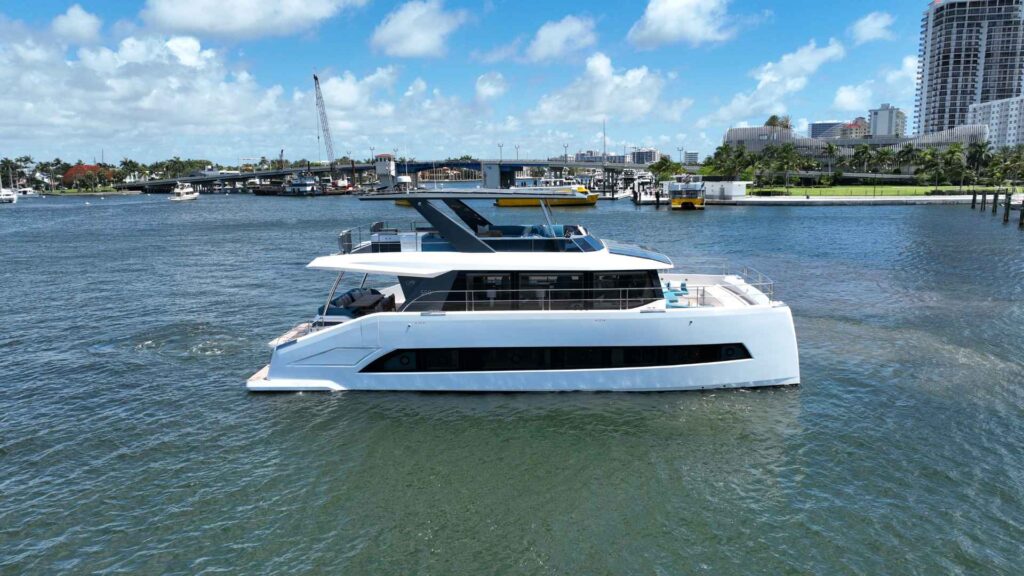
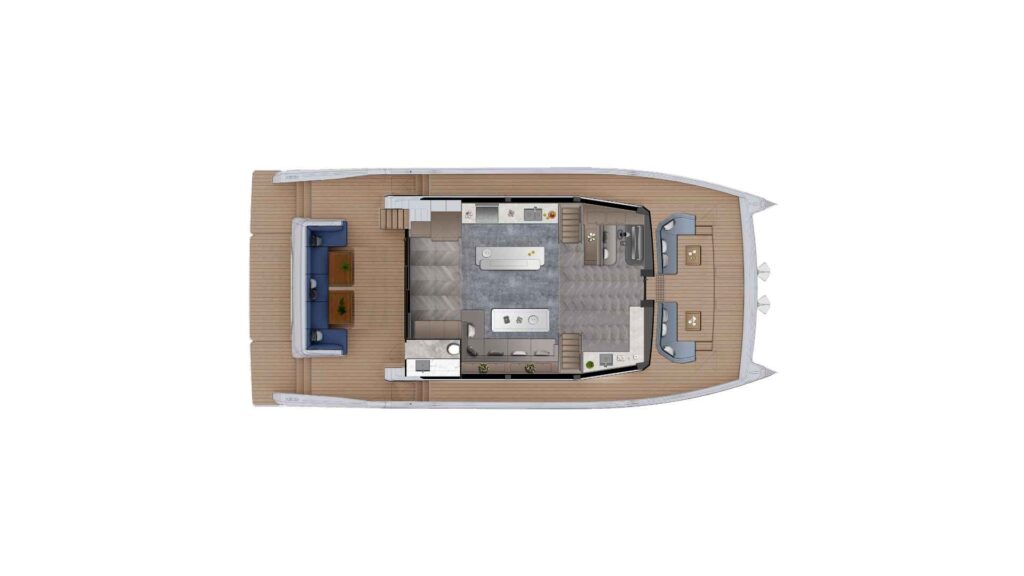
Space is where the power catamaran vs sailing catamaran comparison diverges most visibly. Delete the rig and everything above the bridgedeck changes: no mast passing through the coachroof, no boom sweeping the top deck, no sheets, tracks or winches claiming lounging areas. On the OceanWalker S60 that freedom becomes a flybridge of more than 500 square feet — a genuine second living deck with helm, dining and sunpads — plus near-panoramic glazing that a sailing cat's structure rarely allows, and 6'11" of headroom carried through the accommodation.
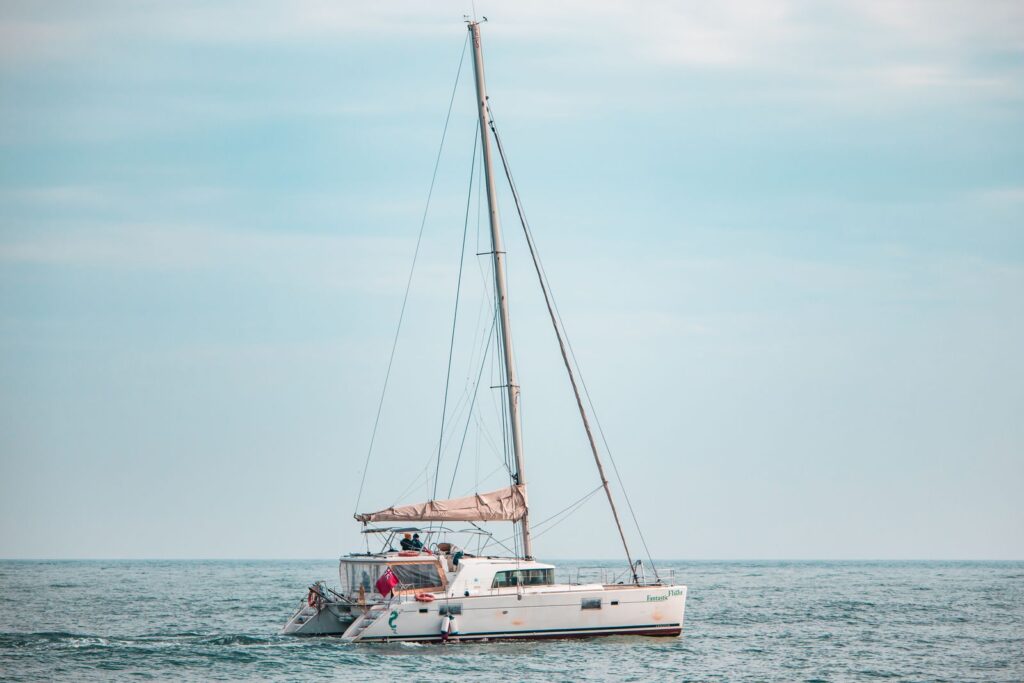
A sailing catamaran of the same length gives some of that back. The mast step, compression post and chainplates dictate structure; the boom limits what the coachroof can carry; and the cockpit must keep working sight-lines and sheet runs clear. Designers manage this brilliantly, but the arithmetic doesn't change: at equal length, the powercat's usable deck and interior volume are larger because nothing aloft is competing for them.
Below decks the gap narrows — both types build their cabins into the hulls, and a 60-foot example of either sleeps eight in comfort. The S60 arranges four en-suite guest cabins with two crew berths aft. What the power catamaran adds is the vertical dimension: with no rig loads to absorb, the saloon can be taller, brighter and wider-windowed, which is precisely what you notice at anchor — where, on either boat, you will spend most of your time. For a fuller tour of that second-deck lifestyle, see our guide to flybridge living on a power catamaran.
Categories blur at boat shows; a power catamaran vs sailing catamaran table doesn't. The power column below is the OceanWalker S60's published specification. The sail column describes what the type structurally requires at this size — where a figure varies by builder, we say so rather than invent one.
| Factor | Power catamaran (OceanWalker S60) | Sailing catamaran (60 ft class) |
|---|---|---|
| Length / beam | 18.87 m (60 ft) / 8.38 m (27'6") | Comparable by class; varies by builder |
| Propulsion | 2 × Volvo Penta D6-440 (880 hp) | Rig + twin auxiliary diesels |
| Top speed | 18 knots, on demand | Wind-dependent; auxiliary motoring slower |
| Range | ~1,500 nm under power | Effectively unlimited under sail; modest tankage under power |
| Silent power at anchor | 9 kW solar (22 panels) + 32 kW generator | Builder-dependent; hotel loads usually generator-led |
| Guest accommodation | 4 en-suite + 2 crew; 6'11" headroom; 500+ sq ft flybridge | Similar cabin count; less top-deck living area |
| Air draft | Low — bridges and most berths accessible | Mast height restricts bridges and some marinas |
| Systems to maintain | Engines, generator, solar | Engines, generator, plus sails, spars and rigging |
| Price & availability | €3.2M all options included — available now, Mediterranean demonstrator | Quoted per configuration; typically ordered to a build slot |
Read down the sail column and a pattern emerges: its advantages concentrate on long passages under sail, its costs on everything else. If your cruising is coastal and Mediterranean, the power column describes the boat you will actually use. See how the S60 fares against named rivals in OceanWalker S60 vs Lagoon Sixty 7 and S60 vs Sunreef 60 Power, and what this class really costs in 60ft power catamaran prices.
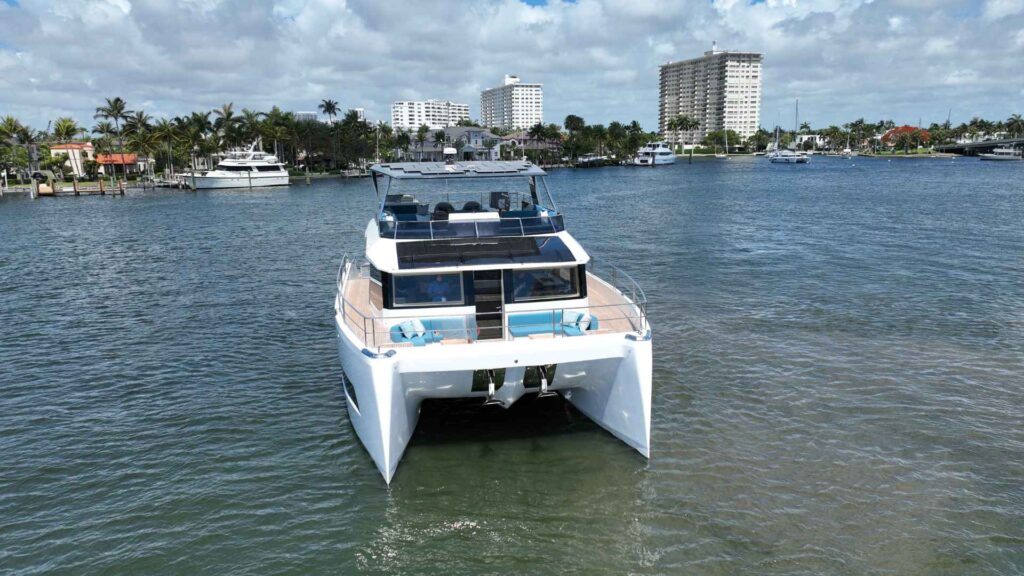
Berthing is the power catamaran vs sailing catamaran difference buyers discover last. Both share the shallow draft that opens anchorages monohulls can't touch — that advantage is a tie. Overhead is where they part. A 60-foot sailing catamaran carries a mast that stands well clear of most bridge and cable clearances, closing rivers, lagoon passages and some inner-harbour berths, and marinas price and place tall rigs accordingly. The power catamaran's low air draft keeps those doors open.
Beam is the constraint the two types share: at 8.38 m the S60 books the same wide berths a sailing cat of its class does, and in high season the Riviera's wide berths are the scarce commodity. Our guides to catamaran beam and volume and power catamarans for sale in Cannes cover the berthing picture; if you are visiting the coast in September, the Cannes Yachting Festival is the one week you can walk both types back-to-back in a single afternoon.
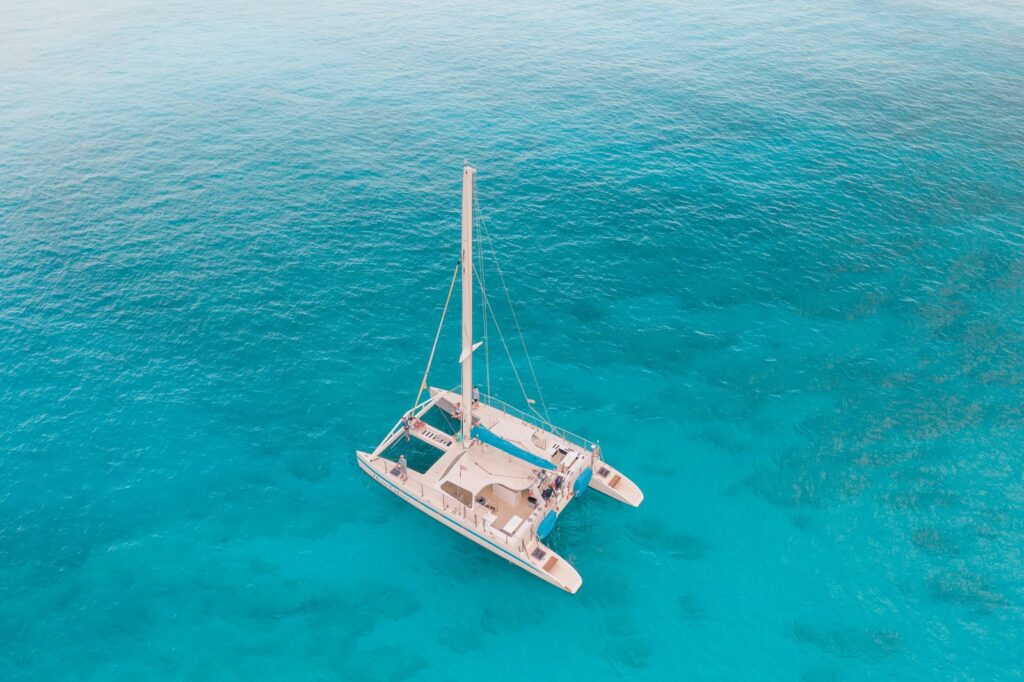
The power catamaran vs sailing catamaran verdict, then. Choose the sailing catamaran if sailing itself is the point — if the passage is the destination, if trade-wind miles are genuinely in your plans, and if tuning a rig sounds like pleasure rather than overhead. It remains the most economical way to cross oceans in comfort, and nothing under power replicates a fast reach in flat water.
Choose the power catamaran if your honest calendar says coastal cruising, anchorages, guests and schedules — if you would rather the space of a 500 sq ft flybridge than a sail locker, and would rather arrive at 18 knots than wait for wind. Independent multihull journals such as Multihulls World have tracked the segment's growth for years, and the reason is simply honesty: buyers matching the boat to their real use. Weigh the wider market in our catamaran comparison hub, see the adjacent power catamaran vs monohull motor yacht question, or go straight to the boat itself: the OceanWalker S60 — sixty feet, intelligently priced, at €3.2M all options included, available now.