Fast facts:
This section of the power catamaran glossary covers the hull and design terms that show up on every spec sheet and every brokerage listing, and that shape how a boat actually feels to own.
LOA (Length Overall) — the boat's full length bow to stern. It's the number every marina berth and haul-out quote is priced against. The OceanWalker S60's LOA is 18.87 m (60 ft).
Beam — the boat's width at its widest point. On a catamaran, beam matters more than on a monohull, because it drives interior volume, stability at rest, and berthing fees — marinas typically price by beam as well as length. The S60's beam is 8.38 m (27'6"), which is what gives its saloon its wide-open feel.
Draft — the depth of the hull below the waterline, the number that decides which marinas and shallow bays are actually reachable. Catamarans typically draft less than an equivalent-length monohull, since load is spread across two hulls rather than one keel — a genuine advantage for buyers planning shallower Mediterranean anchorages; the exact figure should be confirmed with European Yacht Brokers.
Displacement — the weight of water a hull displaces, effectively the boat's all-up weight. It affects fuel burn, ride comfort and load capacity, and matters more to a serious buyer than any marketing photo.
Semi-displacement vs planing hull — a semi-displacement hull, like the S60's, cruises efficiently at moderate speed with a comfortable ride across a wide speed range; a planing hull is built to rise up and skim the surface at higher speed, at the cost of a rougher ride in a chop.
Catamaran vs monohull — a catamaran has two parallel hulls, a monohull has one. The catamaran trades outright top speed for stability at rest, shallower draft, and far more usable interior and deck volume for the same overall length — exactly why the S60's 8.38 m beam buys such a wide saloon.
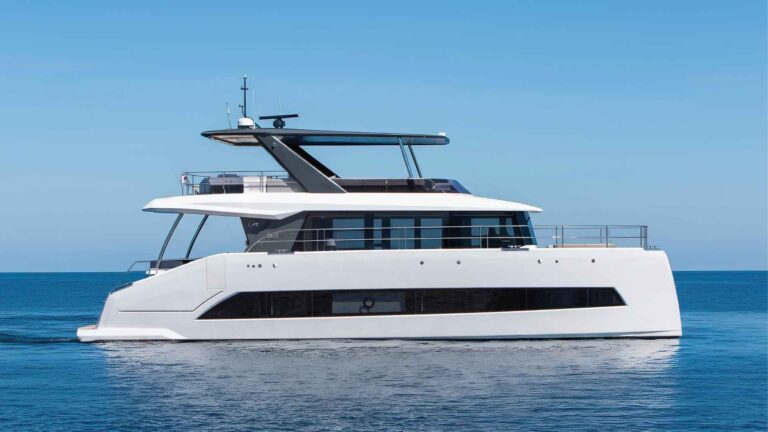
Flybridge — an upper helm and lounge deck above the main saloon roof, with a second steering station, commanding view and usually its own seating. The S60's flybridge is 500+ sq ft, effectively a second full-size entertaining deck.
Hardtop — a rigid, permanent roof over the cockpit or flybridge, as opposed to a canvas bimini. It protects the deck year-round, adds mounting real estate for solar panels and electronics, and lets an owner use the boat comfortably in weather a canvas top wouldn't handle.
Those are the hull and design terms this power catamaran glossary opens with.
The second stretch of this power catamaran glossary covers propulsion and the house systems that decide how comfortable a boat is at anchor, which is where most owners actually spend their time.
Horsepower (hp) — the power output rating for an engine. On a catamaran, always look at combined horsepower across both engines rather than a single per-unit figure; the S60 runs 2 × Volvo Penta D6-440 diesels for 880 hp combined.
Twin-engine propulsion — two separate engines, one in each hull, each driving its own propeller. Beyond redundancy if one engine needs attention mid-passage, twin engines give a power catamaran exceptional close-quarters manoeuvrability, letting it pivot near its own length without a bow thruster.
Generator — an auxiliary diesel engine producing electrical power independent of the main engines, running air conditioning, galley equipment and house systems at anchor or when shore power isn't available. The S60 carries a 32 kW generator.
House battery bank — the boat's central electrical reservoir, storing power for lighting, refrigeration, electronics and AC compressors between charging cycles. On the S60, it's what the optional solar array and the generator both charge into.
Solar-assisted — panels that trickle-charge the house battery bank through daylight hours, reducing how many hours the generator has to run rather than replacing it outright. The S60's optional array is 22 panels producing 9 kW; see this site's solar-assisted power catamarans guide.
Shore power — mains electricity supplied through a dockside connection when berthed, letting an owner run AC and house systems without touching the generator or battery bank. Most Mediterranean marina contracts include shore power as standard.
Black water / grey water — black water is sewage from heads (toilets); grey water is used water from sinks, showers and galley drains. Both are held in dedicated tanks and pumped out at approved facilities rather than discharged near shore or in marinas — a non-negotiable part of Mediterranean cruising etiquette, and in many ports, local law.
Every term above shows up on the S60's own spec sheet, not just in the abstract.
This is the part of the power catamaran glossary most first-time buyers actually came for — the paperwork and ownership terms that get used once a boat is under serious consideration.
VAT-paid status — confirmation that VAT has already been settled on a yacht within the EU, meaning it can move freely between member states without a further liability arising. European Yacht Brokers prepares this documentation as part of every sale; see the full breakdown in this site's EU yacht VAT guide.
CE certification — the mandatory EU conformity mark under the Recreational Craft Directive, confirming a boat has been independently assessed against harmonised safety, structural and emissions standards before it can be sold or used in EU waters. It applies to the specific boat, not the country where it was built — a distinction this site's build-quality guide covers in more depth.
Private viewing — an on-the-water test of a specific boat under real load, the single best way to judge handling and systems before committing to a purchase. Every OceanWalker S60 sale is built around a private viewing and private viewing, not a brochure alone.
Survey — an independent inspection of a boat's hull, systems and structure by a qualified marine surveyor, typically arranged before finalising a purchase. It's the buyer's own due-diligence step, separate from CE certification.
Charter management — a service that markets and operates a privately owned yacht for paying charter guests when the owner isn't using it, generating income that can offset a share of annual running costs; see this site's charter management guide. Commission typically runs 15%–30% of gross charter revenue.
Berth / mooring — a boat's assigned parking space in a marina (berth) or a fixed anchor point in open water (mooring). Mediterranean marina berths for a boat in the S60's class typically run on an annual contract, arranged by European Yacht Brokers as part of every sale.
Haul-out — lifting a boat out of the water, usually onto a yard's hardstanding, for antifouling or major maintenance that can't be done afloat. Most owners schedule at least one haul-out a year.
Liveaboard — using a yacht as a genuine, extended residence rather than for occasional weekend cruising; see this site's liveaboard power catamaran guide. The S60's 4 en-suite guest cabins, 500+ sq ft flybridge and wide 8.38 m beam are exactly the combination that makes extended liveaboard use comfortable rather than cramped.
Every one of these is something European Yacht Brokers handles directly, not something a buyer has to research alone.
The final section of this power catamaran glossary covers the vocabulary that describes how a boat like the S60 actually gets used once it's owned.
Passage-making — covering a genuine point-to-point distance at sea, as opposed to day-hopping between nearby anchorages. It's a different discipline from marina-to-marina cruising, testing range, fuel planning and sea-keeping over hours rather than minutes.
Range — the distance a boat can cover on a full tank at a given cruising speed, the number that decides how far offshore or how many islands a passage-making itinerary can realistically include; see this site's range and passage-making guide. The S60's range is approximately 1,500 nm, comfortably enough for genuine Mediterranean-wide cruising within a season.
Cruising season — the months when weather, sea state and daylight make a region genuinely enjoyable to cruise, typically running roughly May to October across the Mediterranean, with June through September as high season.
Marina vs anchorage — a marina is a serviced harbour with berths, shore power and facilities; an anchorage is open water where a boat sets its own anchor for the night, with no services but genuine privacy and no fee. Most owners mix both, and it's exactly the kind of night at anchor where the S60's solar-assisted house battery bank earns its keep.
Transfer / delivery — moving a boat from its current location to wherever the buyer wants it, typically arranged as part of a completed sale. European Yacht Brokers arranges delivery to the buyer's chosen country as standard.
That's the core vocabulary this power catamaran glossary set out to cover. For the model these terms describe in full, see the OceanWalker S60 page, or browse the rest of the guides hub for deeper reading on any single term above.
For readers who want to go further than this power catamaran glossary, three independent sources are worth checking: Discover Boating's boating terms glossary, the European Commission's guidance on CE marking and the Recreational Craft Directive, and RINA's marine classification and survey services page, a real class society reference for the survey terms above.
No. This power catamaran glossary is a reference to consult as terms come up, not a syllabus to memorise — part of European Yacht Brokers' job is explaining every term in context as a purchase progresses.
VAT-paid status and CE certification tend to matter most early on, since they directly affect what a buyer is entitled to do with a boat once purchased; both are explained above with links to fuller guides.
Largely, yes. Rigging and sail-trim vocabulary common to sailing glossaries doesn't apply to a power catamaran like the S60; the terms that matter here are propulsion, hull design, house systems and ownership process.
Every term on this page maps to the OceanWalker S60's actual specification, viewable on the OceanWalker S60 page, or in person during a private viewing arranged by European Yacht Brokers.
This power catamaran glossary covers the terms buyers most commonly ask about across hull design, power and systems, buying and ownership, and cruising — if a term isn't here, European Yacht Brokers can define it directly as part of any enquiry.
Ready to see this power catamaran glossary on a real boat?
Book a private viewing of the OceanWalker S60 — €3.2M, all options included — and European Yacht Brokers will walk you through every spec, term and document in person.
Book a Private Viewing