Fast facts:
The single biggest lever on real-world range is cruising speed, because diesel engines burn disproportionately more fuel per mile as speed climbs rather than linearly. Running near an economical cruising speed burns far less fuel per nautical mile than pushing toward top speed, and the fuel-burn curve on twin marine diesels like the S60's Volvo Penta D6-440s gets noticeably steeper in the upper rev range. A boat with a stated power catamaran range of roughly 1,500 nm at economical cruise can see that figure fall substantially if run consistently at higher RPM — the number on a spec sheet always describes one specific speed, not every speed.
Beyond throttle setting, sea state and load are the other two variables that move real-world range in practice. Headwinds and a building sea increase resistance and fuel burn for any given speed, sometimes significantly on longer open-water legs, while calm conditions and a following sea do the opposite. Load matters too — fuel, water, guests, tender and stores all add displacement, and a fully provisioned boat loaded for an extended passage won't stretch to the same range as a lightly loaded boat on a day out. None of this is unique to catamarans, but it's the honest starting point for any power catamaran range conversation: a single nautical-mile figure is always a best-case number, not a guarantee. A buyer planning a specific passage is better served asking about fuel burn at a realistic cruising RPM than quoting the top-line figure on its own.
Buyers weighing power catamaran range against a similar-size monohull are really asking about hull efficiency. At the displacement and semi-displacement cruising speeds most owners actually use — rather than a flat-out planing run — a catamaran's slender twin hulls generally generate less wave-making resistance than a single, wider monohull of comparable length, and that translates into lower fuel burn per mile at a given cruising speed. It's a genuine, widely recognised factor in the wider fuel-efficiency picture, not a marketing invention.
It isn't the whole story, though. A catamaran has more total wetted surface area than a single hull, simply because there are two of them, and running two engines instead of one adds its own fuel draw. So the twin-hull efficiency case is strongest specifically at the cruising speeds and load conditions most owners actually use, not at every RPM across the board. For a buyer, the practical takeaway is that a power catamaran range figure earned at sensible cruising speed is a fair, defensible comparison against a monohull's — it just isn't automatic at any speed. Beam matters too: the S60's 8.38 m beam gives useful interior volume and stability, but a wider boat also has to push more water aside at speed than a narrower monohull hull of the same length, which is part of why cruising speed choice, not hull type alone, does most of the work on real fuel burn.
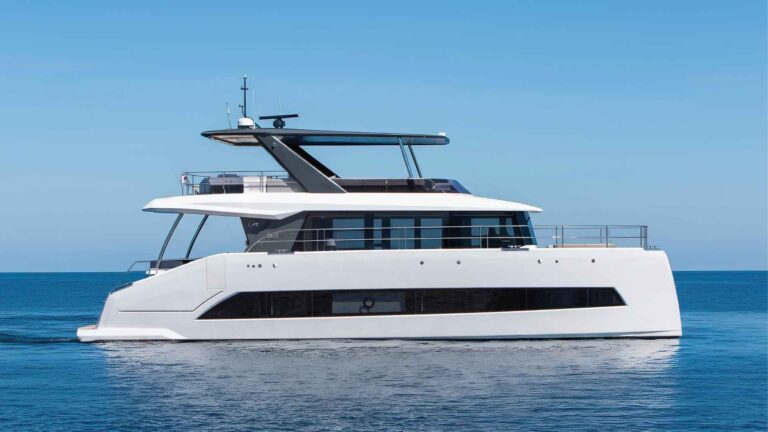
The OceanWalker S60 carries twin Volvo Penta D6-440 diesel engines, 880 hp combined, giving a stated power catamaran range of approximately 1,500 nm — enough to cover the great majority of Mediterranean passages an owner is likely to want to run without refuelling mid-leg. Top speed is 18 knots, though as with any boat in this class, that stated figure applies at an economical cruising speed well below the top end, not at wide-open throttle.
The S60 doesn't publish a single fixed cruising speed, and that's an honest omission rather than a gap — actual cruising speed, and the fuel burn behind it, depends on how an owner runs the boat, sea state on the day, and how heavily she's loaded. What the stated ~1,500 nm figure does give a buyer is a credible planning number: enough power catamaran range, at sensible cruising speed, to run any of the passages set out below with a genuine safety margin in hand, rather than treating the tank as empty at the destination.
The most useful way to think about power catamaran range isn't an abstract number, it's real legs. Within European Yacht Brokers' Mediterranean territory, three routes come up often when owners plan a passage: Cannes to Corsica — roughly 110–120 nm to Calvi, depending on exact departure and arrival points; Palma de Mallorca to Ibiza — roughly 75–85 nm; and Athens to the Cyclades, where Piraeus to Mykonos is a commonly used benchmark at around 85–90 nm. All three are approximate distances, not fixed waypoint-to-waypoint figures, and should be checked against the actual route plotted on the day.
Every one of those legs sits comfortably within the S60's stated range at economical cruise, even allowing for a return leg without refuelling, weather margin, and genuinely conservative planning rather than running the tank down to reserve. That's the real test of a power catamaran range figure for a buyer in this territory: not whether the number looks big on a spec sheet, but whether it comfortably covers the passages this agency's owners actually run — Cannes to Corsica and back, an island-hopping week between Palma and Ibiza, or a Cyclades run out of Athens — with margin to spare, not a nail-biting fuel gauge on arrival.
Solar doesn't add nautical miles to the S60's main-engine power catamaran range directly — the 22-panel, 9 kW array feeds the house battery bank, not the Volvo Penta D6-440s. But on a longer passage, or a multi-day cruise strung between the routes above, that distinction matters less than it sounds: solar reduces how much the 32 kW generator needs to run to cover hotel loads at anchor along the way, which means less generator fuel burned overnight and, in practice, more of the boat's total fuel capacity genuinely available for propulsion rather than house power. For the full mechanics of how the array works with the S60's generator and battery bank, see the solar-assisted power catamarans guide.
On a passage like Athens to the Cyclades, or a multi-night Corsica loop, where the boat may anchor for a night or two along the way rather than running straight through, that generator-hour saving is exactly where solar earns its keep. It's a comfortable-range extension for a working fuel budget, not a headline nautical-mile number, but it's a real one for owners who anchor out rather than plug into shore power every night of a passage. Owners running longer, multi-leg itineraries — a full Cyclades circuit rather than a single Athens-to-Mykonos hop, for example — tend to notice the difference most, simply because there are more overnight anchorages along the way for the array to help cover.
A stated power catamaran range figure is a planning number; a private viewing is where a buyer checks it against reality. European Yacht Brokers' standard S60 private viewing gives a prospective owner the chance to run the boat at a genuine cruising speed rather than a brochure figure, watch fuel-flow instrumentation directly, and ask about burn rate at the RPM they'd actually use on a real passage — full detail on arranging one is on the private viewing page.
Worth asking specifically: fuel burn in litres or gallons per hour at a sensible cruising RPM, not just at idle or top speed; how burn changes as the boat comes onto plane versus sitting at displacement speed; and how the crew would actually plan a specific delivery route within the boat's real-world range. That last question is one European Yacht Brokers can genuinely help with — route planning for a specific delivery, using the boat's real private viewing numbers rather than a generic spec sheet, is part of the conversation every serious S60 private viewing includes. It's a more useful exercise than comparing spec sheets side by side, because it puts a buyer's own intended use — day trips, a full Mediterranean season, or a specific delivery passage — against real numbers rather than a manufacturer's best-case scenario.
For readers who want the underlying propulsion and passage-planning detail, two independent sources are worth checking directly: Volvo Penta's official D6 marine engine specification page for the diesels fitted to the S60, and PredictWind's marine weather routing service for the kind of forecasting that affects real power catamaran range on any open-water passage.
The S60 doesn't publish one fixed cruising speed — actual speed depends on sea state, load and how the owner runs the boat — but top speed is 18 knots, and the stated ~1,500 nm range figure applies at a more economical cruise well below that, not at wide-open throttle.
Generally yes at typical cruising speeds — slender twin hulls create less wave-making resistance than a single wider monohull at displacement and semi-displacement speeds, a real factor in the power catamaran range conversation — though a catamaran also carries more wetted surface and two engines, so the advantage is strongest at sensible cruising speed rather than at every RPM.
Significantly. Headwinds and a building sea increase fuel burn for any given speed, while calm conditions and a following sea reduce it, so real-world range on a specific day can vary meaningfully from a stated best-case figure — which is exactly why checking a weather routing forecast before a longer passage is standard practice, not an extra precaution.
Not directly — solar feeds the house battery bank, not the main Volvo Penta D6-440 engines — but it cuts generator runtime for hotel loads at anchor on a multi-day passage, which in practice leaves more of the boat's fuel capacity available for propulsion rather than house power.
Yes — route planning for a specific delivery, using the S60's real private viewing fuel-burn numbers rather than a generic spec sheet, is something European Yacht Brokers can advise on directly as part of the buying and delivery process.
Within this agency's Mediterranean territory, legs like Cannes to Corsica (roughly 110–120 nm), Palma to Ibiza (roughly 75–85 nm) and Athens to the Cyclades (roughly 85–90 nm to Mykonos) all sit comfortably inside the S60's stated power catamaran range at economical cruise, with margin to spare for weather and a return leg.
See the S60's real power catamaran range for yourself
Book a private viewing — committed buyers can check fuel burn and cruising speed on the water as part of the purchase process — then talk to European Yacht Brokers about route planning for your own Mediterranean passage.
Book a Private Viewing