
Fast facts:
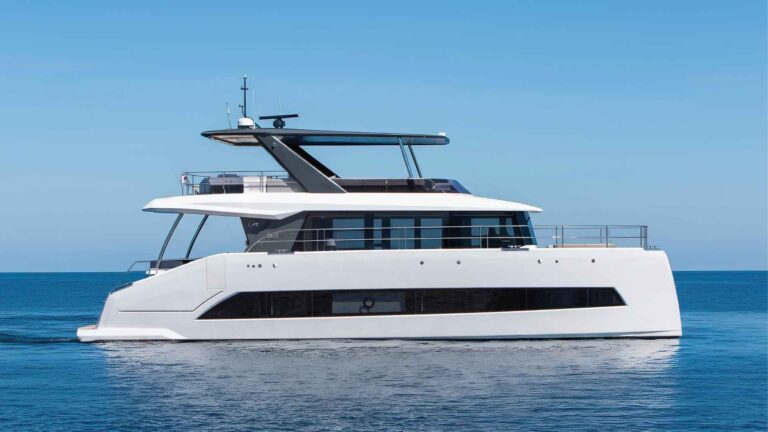
The single biggest difference between a liveaboard power catamaran and a liveaboard monohull is felt within the first hour aboard: there's no heeling. A monohull leans under sail or rolls uncomfortably at anchor in a beam swell; a power catamaran like the OceanWalker S60 sits flat, at anchor and underway, because its stability comes from beam rather than a deep ballasted keel. For anyone actually living aboard rather than weekending, that's not a minor comfort detail — it's the difference between cooking a proper meal, sleeping through the night, and having guests aboard without everyone bracing against a slope.
The second difference is usable volume. The S60's 8.38 m beam spreads the boat's interior across two hulls plus a full-width bridgedeck saloon, which produces meaningfully more walk-around space and storage than a monohull of the same 18.87 m LOA can offer from a single narrow hull. That extra beam is also what makes this kind of layout possible in the first place: four en-suite guest cabins plus two crew cabins, each set in its own hull rather than stacked fore-and-aft off a single central corridor. The result is separate cabin “pods” with real acoustic and visual privacy between them — a family or a couple hosting guests can be at opposite ends of the boat and barely hear each other, something a comparable monohull's single-hull layout genuinely cannot replicate.
Mornings on a liveaboard power catamaran start in the galley, and on the S60 that's a genuine working kitchen rather than a boat-sized compromise: it opens directly onto the saloon and out to the aft cockpit, so whoever's making coffee is part of the conversation, not isolated below. That open galley-to-saloon flow is possible precisely because the bridgedeck doesn't have to fight for space around a mast step or a deep bilge the way a monohull's saloon does — it's one of the quieter, more practical payoffs of the catamaran layout that only shows up once you're actually living with it day to day.
Through the day, the four en-suite cabins function as real private rooms rather than berths to sleep in and vacate — each has its own head, so a family or a group of guests isn't queuing for a single shared bathroom, which matters far more when the boat is actually a home than it does on a week's charter. Evenings move up to the flybridge or back to the cockpit, and because the S60 sits flat at anchor, dinner up top isn't a balancing act. That flat, stable platform, more than any single spec line, is what daily life aboard a liveaboard power catamaran actually feels like once the novelty of the first week wears off.
At over 500 sq ft, the S60's flybridge is genuinely usable outdoor living space, not just a second helm station with a sunpad bolted on. It's large enough for a full dining set, a proper lounge area and shade, and it effectively becomes a second living room for anyone actually living aboard — the space most owners default to for breakfast, sundowners and everything in between, weather permitting across a long Mediterranean season.
What makes those flybridge mornings genuinely quiet is the S60's optional 22-panel, 9 kW solar array, which feeds the house battery bank alongside the boat's 32 kW generator. It doesn't replace the generator, but it materially cuts how many hours it needs to run overnight to keep the fridge, lighting and air conditioning going — which means fewer mornings waking up to generator drone drifting across the anchorage. For a liveaboard power catamaran specifically, where the boat is occupied every day rather than a few weekends a season, that quieter baseline compounds into a genuinely different daily experience. The full mechanics of how the array and generator work together are covered in this site's solar-assisted yachts guide.
Provisioning a liveaboard power catamaran is closer to running a small household than stocking a boat for a weekend: owners genuinely aboard full-time or for extended stretches tend to settle into a rhythm of a proper supermarket run every week to ten days, topped up with local market visits for fresh produce, rather than one huge shop at the start of a season. The S60's four-cabin, six-berth-plus-crew layout gives real galley storage and refrigeration to support that rhythm, but provisioning logistics still depend heavily on which marina or anchorage a boat is based in — a berth walking distance from a town centre makes this genuinely easy, while a remote anchorage means planning trips around tender runs or a hire car.
Water and holding-tank capacity are the other honest variable, and it's worth being straightforward about this rather than inventing a number: exact tank capacities aren't published in the S60's specification sheet, so any buyer planning a genuine liveaboard routine should confirm the current figures directly with European Yacht Brokers as part of a private viewing, alongside how the boat's watermaker (if fitted) and holding-tank pump-out schedule actually work in practice. What's true generally for a boat in this size class is that marina berths with shore water hookups remove most of the pressure entirely, which is one more reason marina choice matters as much as the boat's own tankage for anyone planning to live aboard for real stretches of time.
Whether a marina actually allows someone to live aboard full-time, and for how long, varies genuinely by location — this isn't a detail European Yacht Brokers glosses over, because getting it wrong after a buyer has already committed to a berth is a real problem, not a paperwork technicality. At Marina de Vilamoura in the Algarve, the marina's scale and long, mild season (a practical cruising window running March through November) make it one of the more liveaboard-friendly bases in the agency's territory, though winter still typically means haul-out or covered storage for most owners rather than staying wet year-round. At Cannes, berthing at a working marina like the Vieux-Port or Port Pierre Canto comes with its own seasonal and contractual terms that are genuinely different from Vilamoura's.
That variation is exactly why European Yacht Brokers arranges the mooring directly as part of every sale rather than leaving a buyer to interpret marina rulebooks alone: liveaboard allowances, minimum-stay contracts and winter storage terms are confirmed for the specific marina a buyer chooses, before they commit to a home berth for a liveaboard power catamaran. There's also a separate, non-marina factor worth knowing about for buyers cruising outside their home country: non-EU nationals cruising the Schengen area are generally limited to 90 days within any rolling 180-day period, a rule cruisers discuss at length on forums such as Cruisers Forum's thread on maximum stay in the Mediterranean — a genuinely separate question from marina liveaboard policy, and one worth raising with the agency alongside berthing.
Being honest about fit matters more than selling a lifestyle. The S60 suits couples particularly well — two people using four en-suite cabins get genuine spare-room flexibility for guests and a home office, without ever feeling cramped, and the flat, stable ride removes most of the daily friction that makes full-time boat life hard on a monohull. Small families with a child or two work too, especially when the kids are old enough to have their own cabin pod rather than sharing, since the hull-separated layout gives real distance between a parents' cabin and a children's cabin at the far end of the boat.
Where honesty matters most is full-time versus seasonal use: most owners in this class run a liveaboard power catamaran as a semi-retirement or seasonal liveaboard arrangement — several months aboard through spring, summer and autumn, with winter spent ashore or the boat hauled out — rather than genuine twelve-months-a-year occupancy. That's not a limitation of the S60 specifically; it reflects how most owners in this size class actually use a boat, and provisioning, marina and haul-out logistics across this agency's territory are generally built around that seasonal rhythm rather than year-round occupancy. A buyer set on true full-time, year-round liveaboard use should raise that explicitly with European Yacht Brokers, since it changes the berthing and maintenance conversation from the outset.
For readers researching liveaboard power catamaran life further, one independent source is worth checking directly: Yachting World's own first-hand account of lessons learned living aboard and cruising the Mediterranean, a useful outside perspective on the wider liveaboard lifestyle alongside the S60-specific detail on this page.
The S60's four en-suite guest cabins plus two crew cabins comfortably suit a couple, a small family, or a couple hosting regular guests. A liveaboard power catamaran in this class is genuinely spacious for two to six people, less so if every cabin is occupied full-time long-term.
Galley and cabin storage on the S60 supports a normal weekly-to-ten-day supermarket routine rather than constant small trips, though how easy provisioning actually is depends heavily on the marina or anchorage — a town-centre berth makes liveaboard power catamaran life noticeably simpler than a remote anchorage.
Some owners do, but most run a liveaboard power catamaran seasonally — aboard through spring, summer and autumn, with winter spent ashore or hauled out, since many marinas price and structure long-stay contracts around that seasonal pattern rather than year-round occupancy.
No — liveaboard and long-stay policies vary genuinely by marina across the agency's territory. European Yacht Brokers confirms the specific terms for a buyer's chosen marina, such as Vilamoura or Cannes, as part of arranging the mooring.
Yes — mooring is arranged directly by European Yacht Brokers as part of every sale, including confirming liveaboard allowances, minimum-stay terms and winter storage options for the specific marina a buyer chooses.
Exact tank capacities for the S60 aren't published in its specification sheet; buyers planning genuine liveaboard use should confirm current figures and watermaker/pump-out arrangements directly with European Yacht Brokers during a private viewing.
See what liveaboard power catamaran life is really like
Step aboard the OceanWalker S60 at a private viewing and walk the cabins, galley and flybridge for yourself — €3.2M, all options included.
View the OceanWalker S60