OCEANWALKER S60E
Der electric luxury power catamaran has stopped being a boat-show concept and become a boat you can specify, price and take delivery of. The OceanWalker S60E shares the 18.87 m hull and 8.38 m beam of the diesel S60 and the same four en-suite cabins, but replaces the engine room with two 150 kW electric motors, 282 kWh of LiFePO4 storage and a rooftop photovoltaic generation system. It is sold across nine European countries by European Yacht Brokers, with delivery, berth and first-year maintenance included in every sale.
Schnellfakten
Auf dieser Seite
An electric luxury power catamaran is not a diesel boat with the engines lifted out and motors dropped in. The naval architecture has to be reconsidered from the waterline up, and the catamaran platform is the reason the arithmetic works at all. Two slender hulls generate far less wave-making resistance than a single displacement hull of the same volume, so the power needed to hold a useful cruising speed falls to a level that batteries can actually sustain for a day at sea.
The second advantage is where the weight goes. On the S60E the two 141 kWh LiFePO4 clusters sit low and outboard, one in each hull, which puts nearly three tonnes of battery mass exactly where a naval architect would ask for ballast. On a power catamaran the same installation raises the centre of gravity and costs you stability; on an electric luxury power catamaran it improves the ride.
Then there is what you lose, which is mostly noise. There is no engine room, no exhaust note, no vibration transmitted through the saloon sole at anchor and no diesel smell in the aft cabins. Two 150 kW motors deliver full torque from zero revolutions, so close-quarters handling in a crosswind is more precise than any shaft-drive diesel installation, and the boat spins on its axis using differential thrust without touching a bow thruster.

This is where most electric boat marketing becomes evasive, so here are the figures we hold. Top speed on the S60E is 12 knots. Design cruising speed is 8 knots. Range is quoted on request rather than printed, because it depends on the final battery specification, the load carried and the generation package chosen, and we would rather confirm a number in writing for your configuration than publish an optimistic one here.
Eight knots is not a compromise on a 60-foot catamaran; it is close to the speed at which the hull is most efficient, and it is the speed at which most owners actually cross between anchorages. The difference is that the diesel S60 will hold 18 knots when the weather closes in and you want to be somewhere else, and covers roughly 1,500 nautical miles between fills. The S60E answers that requirement differently, through two 55 kW diesel range extenders that charge the banks under way rather than driving the propellers.
That architecture matters. A range extender is a generator sized for the average load, not the peak, so it runs at its most efficient point or not at all. In practice an owner will spend most of a Mediterranean season on battery and solar alone, and call on the extenders for long passages or a run home against weather.
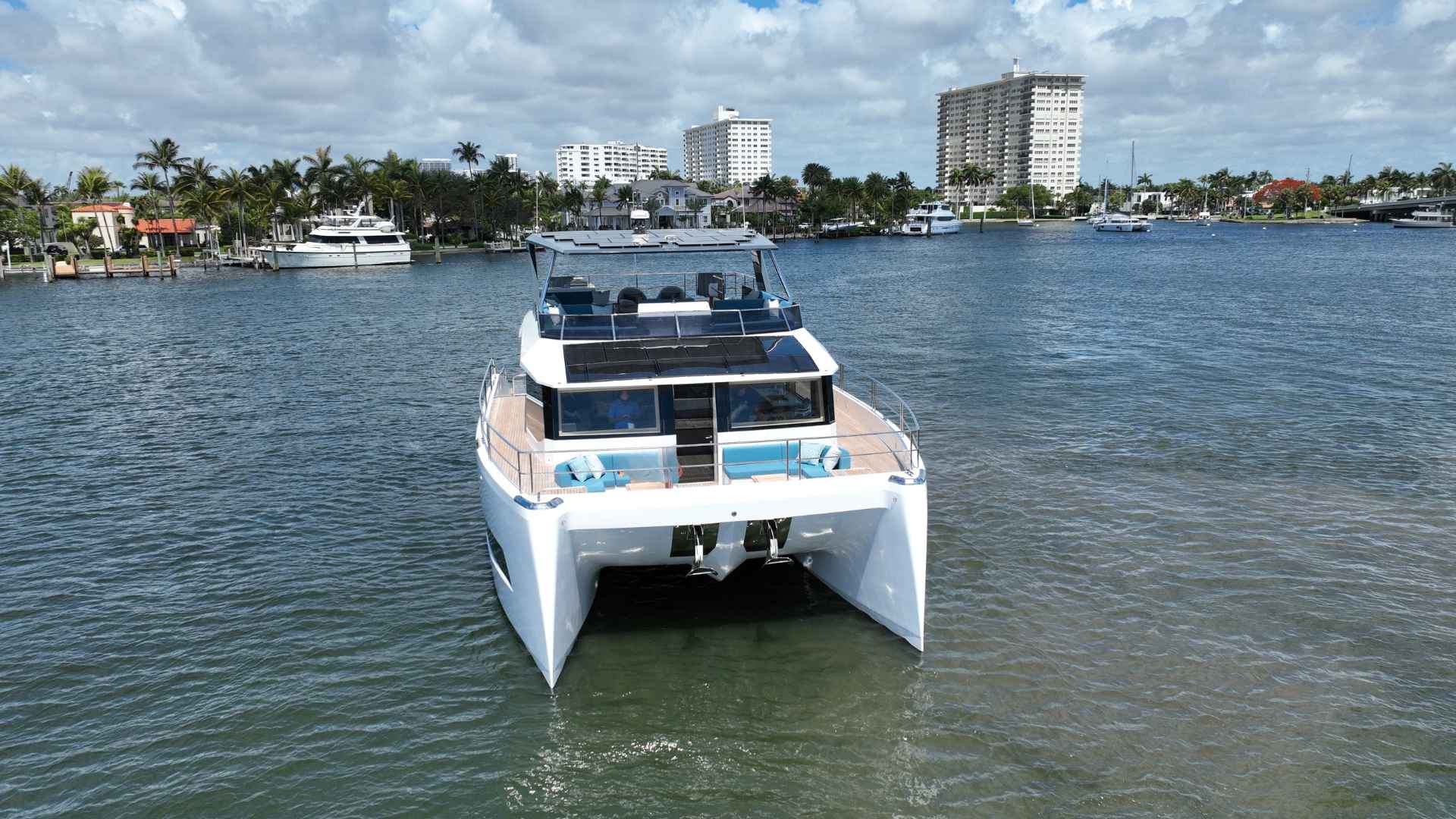
The S60E carries a rooftop photovoltaic generation system across the hardtop and flybridge coachroof. Its sister ship, the diesel S60, carries 22 panels rated at 9 kW, which gives a fair indication of the surface area the OceanWalker platform offers, and it is a great deal more than a monohull of the same length can present to the sun. A wide bridgedeck is, for solar purposes, a roof.
Storage is 282 kWh across two 141 kWh LiFePO4 clusters. Lithium iron phosphate is the deliberate choice over higher-density chemistries: it is the safest lithium chemistry in common marine use, it tolerates partial charge cycles without complaint, and it will still hold a usable proportion of its capacity after several thousand cycles. On a boat that will be charged and discharged daily for twenty years, cycle life is worth more than energy density.
Charging comes from three directions: shore power in a marina, the photovoltaic array whenever the sun is up, and the range extenders when neither is enough. The practical consequence is that an owner at anchor runs air conditioning, watermaker and induction galley overnight in silence, with no generator cycling on at three in the morning. For a great many buyers that single fact is the whole argument for an electric luxury power catamaran.

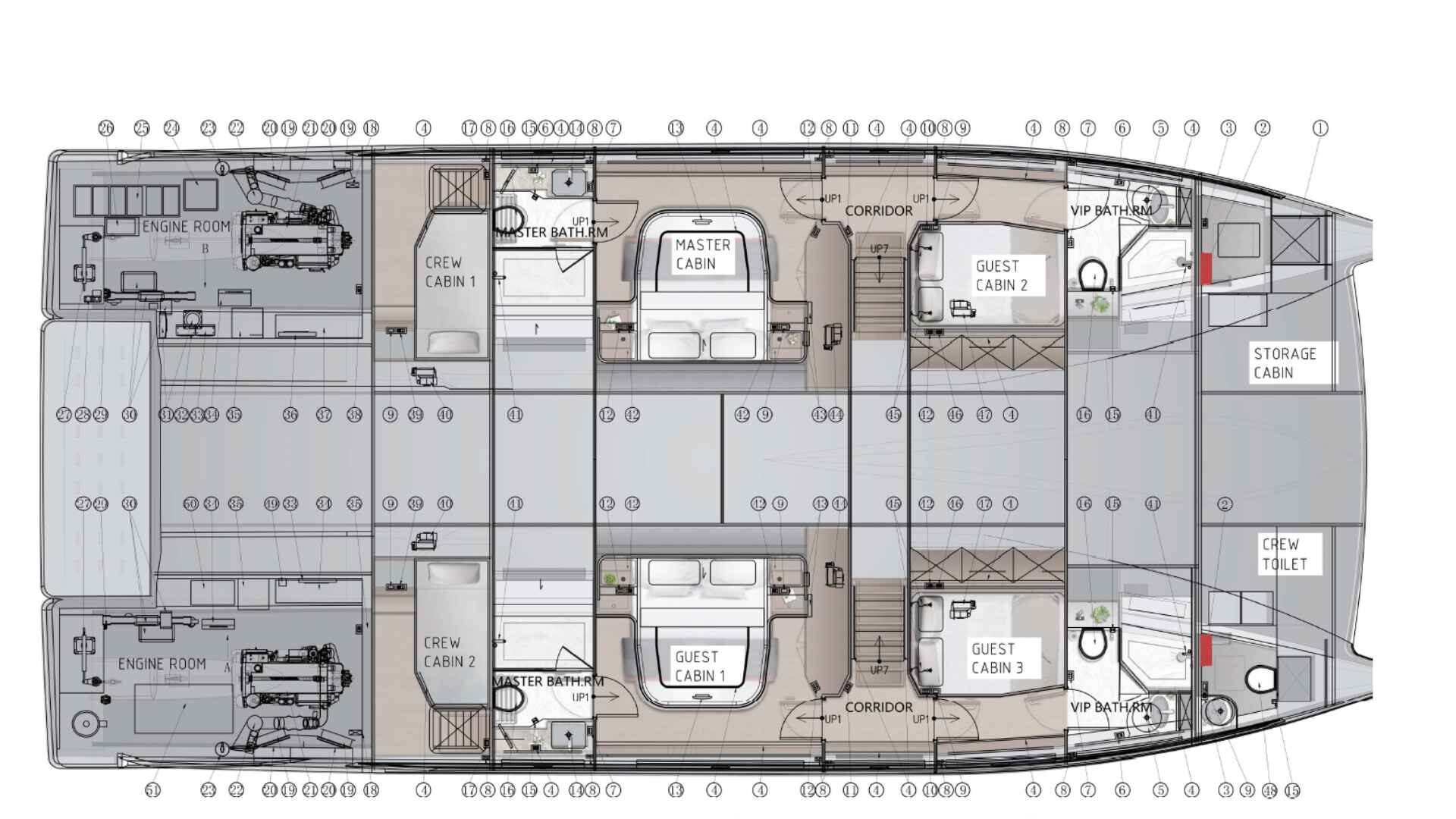
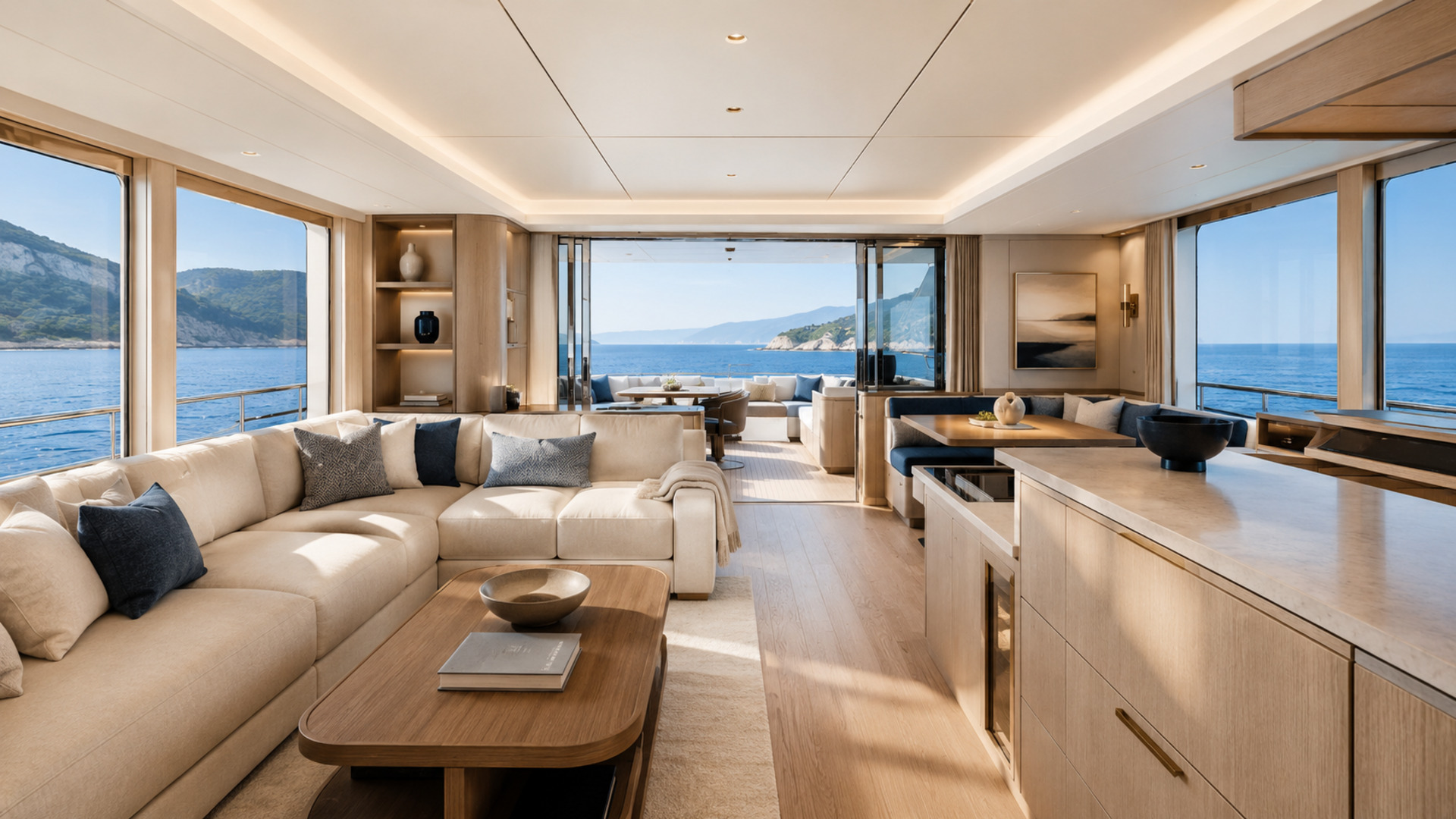
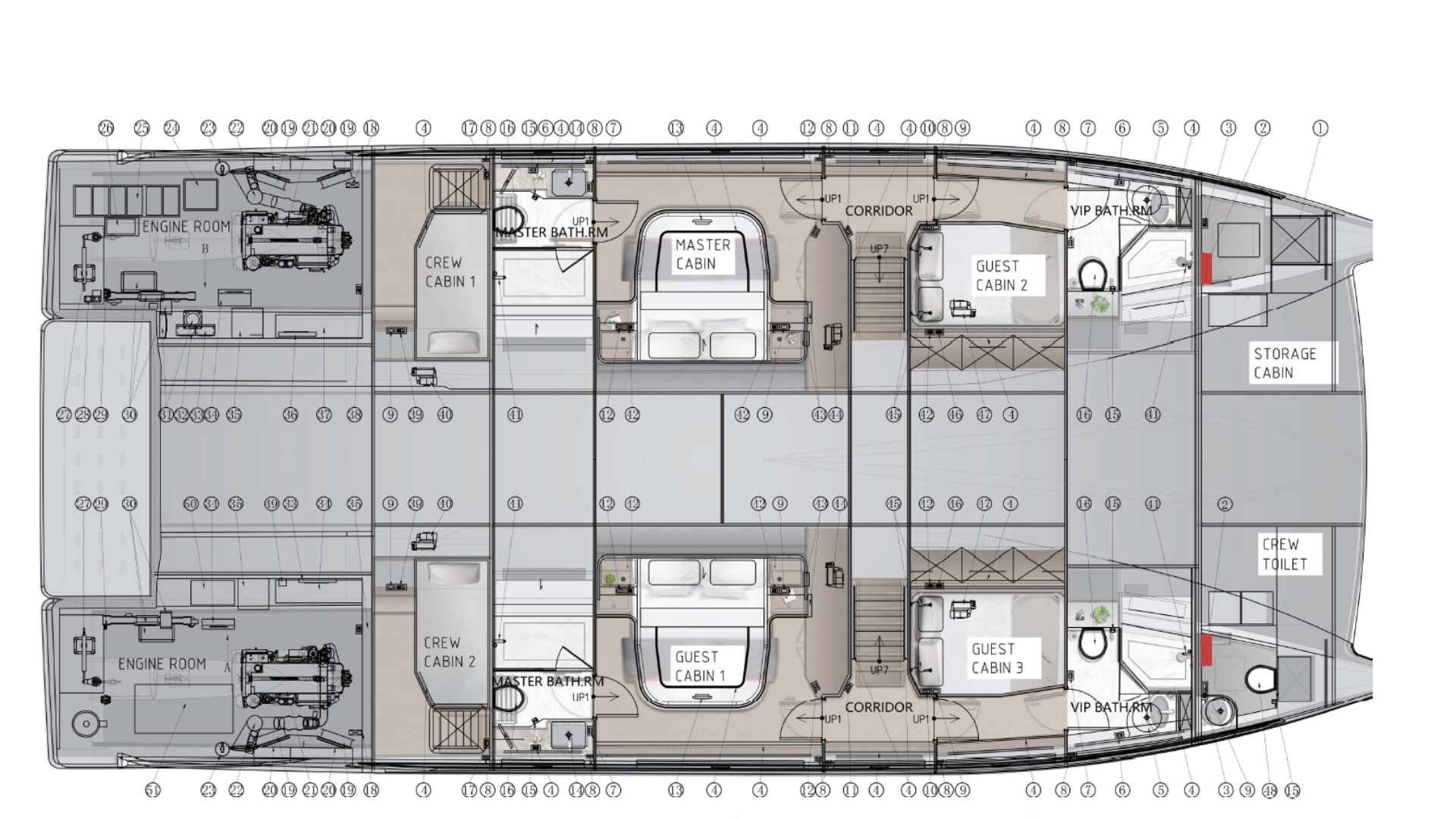
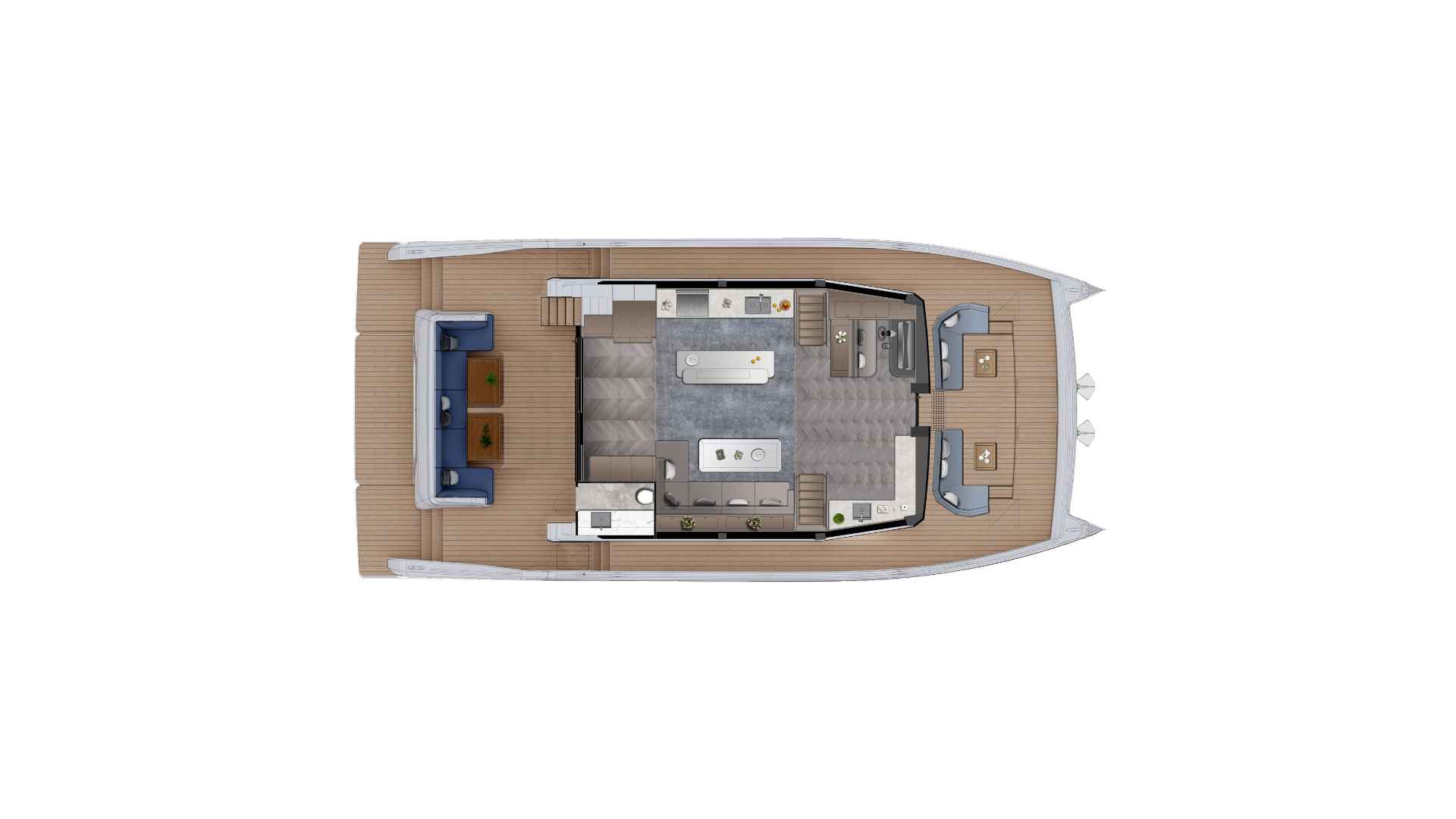
The accommodation is unchanged from the diesel S60, which is the point. Four en-suite guest cabins, two crew cabins, 6ft 11in of headroom throughout and a flybridge of more than 500 square feet. Nothing has been surrendered to the propulsion package, because the propulsion package occupies less volume than the one it replaces.
What changes is the character of the boat at rest and at low speed. Coming alongside, the only sound is the water. At anchor there is no generator, so the aft cockpit is usable in a way that a conventional flybridge motor yacht's simply is not once the sun goes down and the air conditioning is called for. Owners who have moved from a diesel motor yacht to an electric luxury power catamaran consistently describe the silence at anchor as the thing they underestimated.
Servicing changes too. There are no oil changes, no impellers, no fuel polishing and no exhaust elbows on the main propulsion. The range extenders still require conventional maintenance, and the diesel S60 uses Volvo Penta D6-440 units that are supported in every European port we operate in. Both boats are covered by the same agency maintenance arrangement, and the first year is included in the purchase.
We sell both and we have no interest in pushing you toward the wrong one. The honest test is how you intend to use the boat.
If your season is spent moving between anchorages a few hours apart, lying at anchor for days at a time, and running a full domestic load in silence, the electric luxury power catamaran is the better boat by a clear margin. If your pattern involves long passages on a schedule, crossing to the islands against a mistral because the charter guests arrive on Saturday, or a home berth without adequate shore power, the diesel OceanWalker S60 remains the more sensible purchase at 18 knots and roughly 1,500 nautical miles of range.
There is a commercial difference as well. The diesel S60 is priced at 3.2 million euros with all options included, and units are available now in the Mediterranean. The S60E is offered at price on application against a preliminary specification, because the final configuration of batteries, generation and range extenders is settled with each owner rather than fixed in a brochure. If you want the numbers side by side, the full OceanWalker specification page holds every published figure for the range, and current availability is listed on our luxury power catamarans in stock page.

Every figure below is taken from the model data held on this site rather than from a brochure. Where a value is preliminary it is stated as such.
| Spezifikation | OceanWalker S60E (electric) | OceanWalker S60 (diesel) |
|---|---|---|
| Gesamtlänge | 18,87 m (60 Fuß) | 18,87 m (60 Fuß) |
| Strahl | 8.38 m (27ft 6in) | 8.38 m (27ft 6in) |
| Gästekabinen | 4 mit eigenem Badezimmer | 4 mit eigenem Badezimmer |
| Crew cabins | 2 | 2 |
| Headroom | 6ft 11in | 6ft 11in |
| Flybridge area | Über 500 Quadratfuß | Über 500 Quadratfuß |
| Antrieb | 2 x 150 kW electric motors | 2 x Volvo Penta D6-440 Diesel (880 PS) |
| Energy storage | 2 x 141 kWh LiFePO4 clusters (282 kWh) | Not applicable |
| Range extenders | 2 x 55 kW diesel | Not applicable |
| Generation | Rooftop PV generation system | 22 solar panels (9 kW) + 32 kW generator |
| Höchstgeschwindigkeit | 12 knots | 18 Knoten |
| Cruising speed | 8 knots | Auf Anfrage |
| Reichweite | Auf Anfrage | Approximately 1,500 nm |
| Preis | On application | 3.2 million euros, all options included |
| Verfügbarkeit | Preliminary. Final specification on request | Available now, Mediterranean demonstrator |
The S60E is offered at price on application. That is not evasion, it is a consequence of the specification still being preliminary: battery capacity, the generation package and the range extender configuration are settled with each owner, and each of those decisions moves the figure materially. We confirm a fixed price in writing against a written specification, and we do not revise it afterwards.
What is included does not change. European Yacht Brokers is the single sales agency for the OceanWalker range across France, Italy, Spain, Portugal, Croatia, Greece, Cyprus, Malta and Germany. There is no dealer network and no local margin stacked on top. Every sale includes delivery to your chosen port, a berth arranged and contracted on your behalf, and the first year of scheduled maintenance. One agency, nine countries, one point of contact from first enquiry to the berth.
For the diesel platform, published figures and what they cover are set out on our Preise für luxuriöse Motorkatamane page. Buyers weighing an electric luxury power catamaran against the diesel boat usually want both documents side by side, and we are happy to send them together.

An electric luxury power catamaran is treated no differently from a diesel yacht for VAT purposes: the rate and the point of taxation follow the flag, the place of delivery and the intended use, not the propulsion system. Rules on temporary admission, chartering and the status of a vessel already in free circulation are set out by the European Commission taxation and customs authority, and we walk every buyer through the position for their specific circumstances. Our EU yacht VAT guide for buyers covers the ground in detail.
Running costs are where the electric platform repays the buyer. There is no fuel bill for propulsion, no main-engine servicing, and a materially lower annual maintenance schedule. Berthing, insurance and crew are unchanged. Shore power and solar between them cover most of a season's domestic load, and the range extenders consume diesel only on passages where they are actually called upon.
Continue reading: OceanWalker S60 diesel • Full specifications • In stock now • Prices • About European Yacht Brokers • Buyer FAQs
An electric luxury power catamaran is a twin-hulled motor yacht driven by electric motors rather than diesel engines. On the OceanWalker S60E that means two 150 kW motors drawing on 282 kWh of LiFePO4 batteries, charged by shore power, a rooftop solar array and two 55 kW diesel range extenders.
Range is confirmed on request rather than published, because it depends on the final battery capacity, the generation package and the load carried. We issue a written range figure for your specific configuration. Design cruising speed is 8 knots and top speed is 12 knots.
The S60E is offered at price on application, because the specification remains preliminary until battery, generation and range extender choices are settled with the owner. The diesel OceanWalker S60 is priced at 3.2 million euros with all options included.
Yes, at the top end. The S60E reaches 12 knots against 18 knots for the diesel S60. At the 8-knot cruising speed most owners actually use, the difference disappears, and the electric boat runs in silence with no generator cycling at anchor.
Two 55 kW diesel range extenders charge the battery banks under way. They are generators sized for the average load rather than the peak, so they run at their most efficient point. The boat is never dependent on shore power alone.
European Yacht Brokers is the single sales agency for the OceanWalker range across nine countries: France, Italy, Spain, Portugal, Croatia, Greece, Cyprus, Malta and Germany. There is no dealer network. Delivery, berth and the first year of maintenance are included.
Send us how you intend to use the boat and we will return a written specification, a fixed price and a realistic delivery date for the OceanWalker S60E. One agency, nine countries, one point of contact.