
Fast facts:
| Specification | OceanWalker S60 | Sunreef 60 Power | Aquila 54 |
|---|---|---|---|
| LOA | 18.87 m (60 ft) | 18.3 m (60 ft) | 16.5 m (54'2") |
| Beam | 8.38 m (27'6") | 10.7 m (35'1") | 7.68 m (25'2") |
| Flybridge / cabins | 500+ sq ft, 4 en-suite + 2 crew | 4–5 en-suite, large flybridge | Compact standard layout |
| Price | €3.2M — all options included | $3.5M–$5.5M (avg $4.4M) | $1.2M–$2.3M |
Read together, the table is really a power catamaran beam and volume spectrum at the 54–60 ft mark: Aquila's narrower 7.68 m beam sits at the compact end, the S60's 8.38 m beam sits in the middle at a genuine 60 ft LOA, and the Sunreef 60 Power's 10.7 m beam sits at the wide end — each extra metre of beam buying more interior volume and costing more, both to buy and to berth.
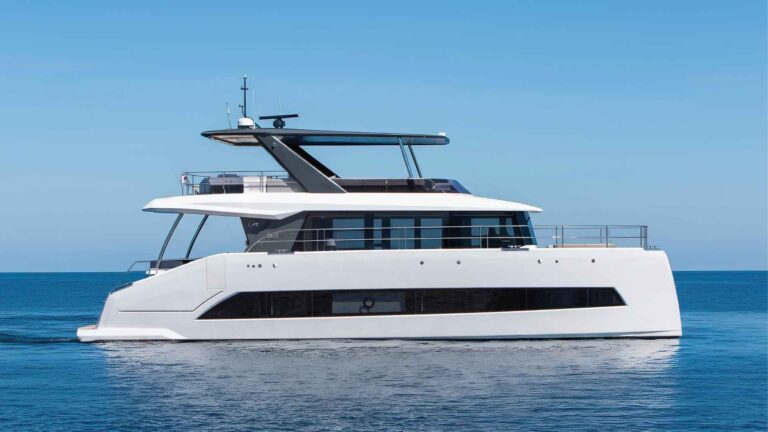
Beam is simply the boat's overall width, measured hull-to-hull at its widest point. On a power catamaran it's a far more consequential number than on a monohull, because beam is the dimension that sets almost everything else: how wide the saloon and galley can be, how far apart the two hulls sit for stability at rest, and how wide a slip or berth the boat needs at a marina. Understanding power catamaran beam and volume together, rather than treating them as separate spec-sheet lines, is the fastest way for a buyer to see what a given hull width is actually worth in daily use.
The relationship isn't linear. A catamaran's usable interior volume comes from the bridgedeck — the flat structure spanning both hulls that carries the saloon, galley and often a cabin or two — and that bridgedeck's width is set directly by beam. Add a metre of beam and the boat doesn't just get a metre wider at the rail; it gains a meaningfully wider bridgedeck across its full length, which is why power catamaran beam and volume tend to move together far more dramatically than length and volume do. That's also why two 60-footers with near-identical LOA, like the OceanWalker S60 and the Sunreef 60 Power, can feel like genuinely different-sized boats once you're standing in the saloon.
On the OceanWalker S60, 8.38 m (27'6") of beam spreads across an 18.87 m (60 ft) LOA to deliver a genuinely wide-open saloon and galley, a 500+ sq ft flybridge, and a fixed 4 en-suite guest cabins plus 2 crew cabins layout with 6'11" of headroom below. That's a real, walk-it-yourself amount of power catamaran beam and volume — wide enough that the galley isn't squeezed against a side deck and the saloon seating doesn't feel like a corridor, which is the actual test that matters more than the metre figure on its own.
Here's the honest comparison this page promised: the Sunreef 60 Power's 10.7 m (35'1") beam is nearly 2.3 m wider than the S60's, on a near-identical 18.3 m LOA — a wider bridgedeck, a bigger flybridge, and Sunreef's option of a 5-cabin, 12-guest layout the S60's fixed 4+2 configuration doesn't attempt to match. The Sunreef genuinely delivers more interior square footage for that extra beam, at a materially higher price averaging around $4.4M against the S60's €3.2M. A full spec-by-spec breakdown is on this site's S60 vs Sunreef 60 Power comparison.
What the S60's narrower beam gives up in outright volume, it recovers in consistency: every square foot of its bridgedeck is built into a fixed, pre-engineered layout rather than spread across a semi-custom range of configurations, so galley, saloon and cabin widths stay consistent hull to hull rather than varying by owner order. For a buyer who wants a completed, inspectable 60-footer rather than a build-to-order project, that's a genuine power catamaran beam and volume trade worth making with eyes open.
No — and this is the point most power catamaran beam and volume conversations get wrong. A catamaran's fundamental stability advantage over a monohull comes from having two hulls separated at all, not from exactly how many metres apart they sit. Two buoyant hulls spaced 8.38 m apart, as on the S60, already create a righting base dramatically wider than any monohull of comparable length relies on with its single hull and keel — that's the structural reason catamarans resist rolling and heeling so much better than monohulls in the first place, and it holds true well below the widest beam figures in the 60 ft class.
It's true that, all else equal, more beam adds some further righting moment — wider hull separation resists heeling force with more leverage, which is one reason sailing-catamaran designers watch beam closely under sail. But a power catamaran isn't managing sail-driven heeling forces, and the stability a buyer feels at anchor or under way comes overwhelmingly from the twin-hull geometry and weight distribution — not from chasing an extra metre of beam once both hulls are already well separated. The S60's 8.38 m beam comfortably clears that threshold, which is why the honest power catamaran beam and volume answer is that the S60 isn't a less stable boat than a wider 60-footer — it traded some extra interior volume for a narrower footprint, without giving up the twin-hull stability that defines the category.
This is the practical side of power catamaran beam and volume that buyers researching interior space alone often miss: beam doesn't just set how roomy a boat feels, it sets how much a marina charges to keep it. Marina pricing is driven chiefly by boat size, and beam is explicitly part of that calculation alongside length and draft — some marinas price per linear metre of length, while others use tiered brackets that account for how much water and dock space a wide-beam catamaran actually occupies. Published French marina pricing guidance notes that a notably wide catamaran can be charged the equivalent of two standard berths rather than one, because it physically displaces that much more slip width regardless of its length.
That's a real, checkable power catamaran beam and volume tradeoff, not a theoretical one. At 8.38 m, the S60 sits comfortably inside the standard beam allowance at most Mediterranean marinas built around 60 ft-class yachts, while the Sunreef 60 Power's 10.7 m beam is wide enough to push into a pricier bracket, or require a wider slip, at marinas that price or allocate space by beam. Buyers shouldn't assume a fixed euro figure here — exact berth pricing varies marina by marina and season by season, and this site's running costs guide sets out the S60's real annual berthing range — but the direction is consistent: narrower beam generally means an easier marina fit and more available berths, while a wider beam can mean fewer slips fit the boat and a higher quoted rate once it does.
Pulling this together, the power catamaran beam and volume decision at the 60 ft mark isn't a question of which number is objectively better — it's a question of which side of the tradeoff a buyer values more. The OceanWalker S60's 8.38 m beam gives up real interior volume against the Sunreef 60 Power's wider 10.7 m platform, and that's worth saying plainly rather than dressing it up: a wider boat has a wider bridgedeck, a bigger flybridge, and more configuration flexibility. What the S60 buys back for that narrower beam is a lower purchase price at €3.2M against Sunreef's average $4.4M, an easier fit at marinas sized around standard 60 ft-class beam allowances, and a completed, inspectable demonstrator rather than a build slot to wait for.
Buyers who prioritise maximum interior square footage and a bigger flybridge should weigh the Sunreef 60 Power's extra beam seriously — the full spec-for-spec case is on the S60 vs Sunreef 60 Power comparison. Buyers who prioritise value and an easier marina fit over the outright maximum on the power catamaran beam and volume scale are exactly who the S60's 8.38 m beam and 500+ sq ft flybridge were built for. Either way, the honest starting point is the same: know what beam actually buys before treating it as a single headline number. Full particulars are on the OceanWalker S60 page.
For readers researching power catamaran beam and volume further, two independent sources are worth checking directly: Yachting World's guide to multihull sailing and stability, and Port Adhoc's independent guide to how marina berth pricing is actually calculated, including how beam factors into the cost.
At 8.38 m (27'6"), the S60's beam sits between the Aquila 54's narrower 7.68 m and the Sunreef 60 Power's wider 10.7 m — a genuine mid-point in the power catamaran beam and volume spectrum at the 54–60 ft mark, on a full 60 ft (18.87 m) LOA.
No. Catamaran stability comes primarily from having two hulls separated at all, not from exactly how wide that separation is. The S60's 8.38 m beam is still far wider than any monohull's effective righting base at this length, so it keeps the full twin-hull stability advantage.
Yes — marinas price berths partly by beam alongside length, and a wide-beam catamaran can be charged more than a standard single-hull rate for the same length. The S60's narrower 8.38 m beam generally means an easier fit and more available berths at marinas sized around standard 60 ft-class allowances.
The S60's 8.38 m beam spans a 500+ sq ft flybridge and a fixed layout of 4 en-suite guest cabins plus 2 crew cabins, with 6'11" of headroom — a genuinely walkable, wide-open saloon and galley, even though it's narrower than the Sunreef 60 Power's bridgedeck.
The S60 is built to a fixed, value-focused specification rather than a semi-custom maximum-volume brief. Its 8.38 m beam trades some interior square footage for a lower €3.2M price, an easier marina fit, and availability as a completed demonstrator rather than a build slot.
Not necessarily — more beam buys more interior volume and flybridge space, but it also raises price, can push a boat into a pricier berthing bracket, and can limit which marinas have a wide enough slip. The right power catamaran beam and volume balance depends on what a buyer values more: maximum space or an easier, lower-cost ownership footprint.
See the S60's beam and volume for yourself
Walk the saloon, galley and cabins in person before deciding how much power catamaran beam and volume you actually need — book a private viewing of the Mediterranean demonstrator.
Book a Private Viewing