Fatti veloci:
Strip away the marketing and a charter management power catamaran arrangement is a fairly simple calendar problem. The owner blocks out the weeks they actually want — typically a handful of high-season weeks plus whatever shoulder-season time suits their own schedule — and hands the rest of the calendar to a charter manager, who markets the boat, handles bookings, briefs crew, and fills as many of the remaining weeks as realistically possible with paying guests. Every euro of charter revenue those weeks generate goes toward the running costs an owner is carrying anyway: berthing, insurance, maintenance and, where the boat carries one, crew.
What makes a charter management power catamaran program work in practice is that it does not ask the owner to give up control of the boat, only of a portion of the calendar. Owner weeks are agreed and locked in first, and a competent manager builds the guest calendar around them rather than the other way round. More weeks released to charter means more potential income and more wear; more weeks reserved for the owner means less income but a boat closer to private-use condition. Most S60 owners settle somewhere in the middle, worth deciding deliberately before signing rather than discovering it a season in.
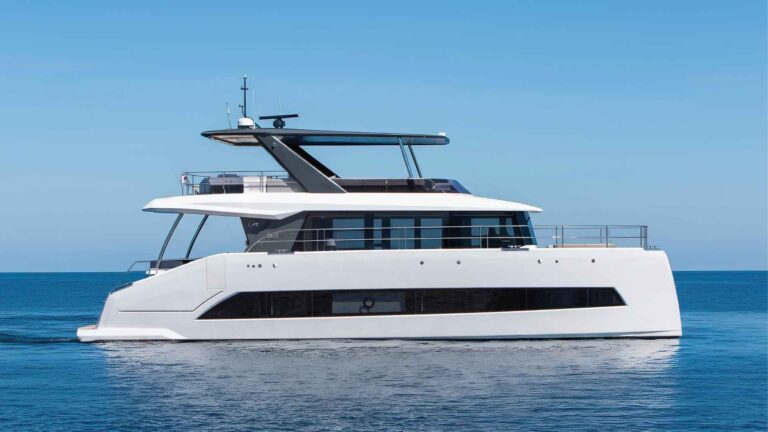
This is the number most owners actually want, and it deserves an honest range rather than a headline figure. Comparable crewed power catamarans in the 55–67 ft class currently publish Mediterranean high-season weekly rates broadly between €25,000 and €48,000, according to published brokerage listings. A charter management power catamaran program built around a newer boat and a first-season crew more realistically prices toward the lower-to-mid end of that published band while the program builds a track record, rather than assuming top-of-market rates from week one.
| Line item | Illustrative range | Appunti |
|---|---|---|
| Weekly charter rate | €18,000–€32,000 | Lower-to-mid end of comparable 55–67 ft crewed Mediterranean rates |
| Realistic booked charter weeks | 6–10 weeks | After owner-use weeks are reserved, across a roughly 20-week season |
| Illustrative gross charter revenue | €108,000–€320,000 | Weekly rate × booked weeks, before any deductions |
| Typical charter management commission | 15%–30% of gross | Paid to the manager for marketing, bookings and guest handling |
| Illustrative net revenue after commission | €76,000–€270,000 | Before extra wear, provisioning shortfalls and added maintenance |
| Compare: total annual running costs | €72,000–€158,000/year | See the guida ai costi di gestione |
Treat every figure above as illustrative, not a guaranteed return — actual results depend heavily on marketing reach, location, boat condition and how consistently the calendar fills. Independent market research, including Mordor Intelligence’s yacht charter market analysis, confirms the Mediterranean remains the dominant charter region by volume, which supports demand for a well-marketed charter management power catamaran, but it does not guarantee any individual boat's booking calendar. A conservative first season should be budgeted at the low end of this range; a strong season, in the right location with an experienced manager, can offset the majority of the S60's annual running costs.
Chartering your own boat for payment is generally a different legal and tax position from owning it privately, and this is the part of a charter management power catamaran decision that benefits most from getting proper advice early. Across European Yacht Brokers’ territory — France, Italy, Spain, Portugal, Croatia, Greece, Cyprus and Malta — putting a yacht into commercial charter typically means registering the vessel for commercial use, which can affect crewing qualifications required on board, safety and survey standards, and how VAT is applied to charter fees rather than to the purchase itself. These requirements vary by country and change over time, so this page describes the general shape of the decision, not the specific rules for any one flag or delivery country.
This overlaps directly with the ground covered in this site's yacht VAT EU buyers guide: a boat's private VAT-paid status and its commercial charter registration are related but separate questions, and moving a boat into charter can have consequences for both. Nothing on this page is formal tax or legal advice, and it should not be treated as a substitute for advice from a qualified tax advisor, customs broker or maritime lawyer licensed in the country where the boat will be registered and chartered. A serious charter management power catamaran plan starts with that conversation, not after the first booking is confirmed. Official EU guidance, including the European Commission’s FAQ on the rules for private boats, is a useful starting point for understanding how commercial status differs from private use, though it should be read alongside advice specific to your situation.
A boat that earns charter income also carries more wear than one used only by its owner, and any honest charter management power catamaran plan accounts for that upfront rather than treating gross income as pure profit. Guest weeks mean more engine hours, more tender use, more interior wear, and a tighter turnaround between charters for cleaning and minor repairs. Reputable charter managers work to a defined maintenance standard between bookings, but that standard, and who pays for what, should be written into the agreement rather than assumed.
Insurance is the other piece owners sometimes overlook. A private hull and machinery policy is not automatically valid for commercial charter use, and most insurers require a separate commercial charter endorsement once a boat starts earning charter income — a gap worth closing before the first paying guest steps aboard, not after an incident. Formal charter bookings are commonly structured on standard terms such as the MYBA charter agreement, which sets out owner and charterer obligations, including how damage and wear are handled, and is worth understanding before signing with any manager.
Not every charter manager runs a program the same way, and the questions below are the ones that actually separate a charter management power catamaran arrangement that protects the boat and the owner's time from one that does not.
An owner who gets clear, written answers to these questions before committing is in a far stronger position than one who signs a standard agreement and hopes a charter management power catamaran program works out as described.
European Yacht Brokers introduces reputable charter managers and licensed crew as part of the standard sales process, the same way the agency introduces buyers to insurance and maintenance contacts covered on the guida ai costi di gestione. For an owner weighing a charter management power catamaran program on a new S60, that means the conversation about owner weeks, realistic income and commercial registration can start alongside the purchase itself, rather than being left for a buyer to work out alone once delivery is complete.
The agency does not operate charter management directly, and it does not promise a specific charter income figure — the honest ranges set out earlier on this page are the right way to plan, not a guarantee any agency can responsibly make. What European Yacht Brokers does do is connect S60 owners with established charter managers and licensed crew operating across its Mediterranean territory, so a genuine charter management power catamaran decision is made with real introductions and real numbers, not cold research alone. For the boat itself, see the OceanWalker S60 pagina, o sfoglia l'intero guida hub for related ownership topics.
Not inherently — a well-maintained boat with documented service history typically resells on its condition and specification, not simply whether it has been chartered. What matters more is whether the charter management power catamaran program maintained the boat to a high standard; a chartered boat with patchy maintenance records is a harder resale than a private-use boat in the same condition.
Generally, yes — chartering a yacht for payment usually requires commercial registration, which can involve different survey, safety and crewing requirements depending on the country. This varies across European Yacht Brokers' territory, and it is not something to assume from private ownership rules; confirm the specifics with a qualified maritime lawyer or the flag registry before committing to a charter management power catamaran plan.
Illustrative figures on this page suggest a booked season of 6–10 weeks could generate net charter income, after commission, in the region of €76,000–€270,000 against total annual running costs of roughly €72,000–€158,000 — meaning a strong season can offset most or all of the running costs, while a conservative season offsets a meaningful share. These are illustrative ranges, not a guaranteed return.
Yes — the agency introduces reputable charter managers and licensed crew as part of the standard sales process, so an S60 buyer interested in a charter management power catamaran program does not have to source one independently.
No — owner weeks are agreed and reserved before the charter calendar is marketed under a properly structured agreement. A charter management power catamaran arrangement is built around the owner's own use, not instead of it.
No. Charter income depends on marketing, season, location and how the boat is maintained and presented; no reputable manager or agency should promise a guaranteed figure, and the ranges on this page should be treated as planning estimates only.
Talk through a charter management power catamaran plan for the S60
€3.2M, all options included — European Yacht Brokers can introduce you to reputable charter managers and licensed crew as part of your OceanWalker S60 purchase.
Visualizza l'OceanWalker S60