Fast facts:
The direct answer to the chinese built yachts quality question is this: quality is a function of a specific yard's tooling, workforce, quality-control process and the componentry it chooses to fit — not a function of which country that yard happens to sit in. A poorly run yard in France can produce a boat with hull print-through, resin-starved laminate and rushed wiring; a well-run yard in China can produce a boat that meets the same CE structural standard as anything built in Europe. Judging Chinese-built yacht quality as a single monolithic category is the same mistake as judging "European-built yacht quality" as one thing — both categories span everything from mass-market production lines to serious, well-controlled manufacturing.
What actually separates a good build from a poor one, regardless of geography, is verifiable: which naval architect and engineer signed off on the design, which classification or CE conformity route the boat went through, which brands of engine, electronics and hardware were specified, and what warranty and after-sales support stand behind the boat. Those are the questions a buyer evaluating chinese built yachts quality should be asking of any specific model — including the OceanWalker S60 — rather than treating "built in China" as a verdict in itself.
Concerns about chinese built yachts quality often assume the practice is new or fringe. It isn't. Over the past decade, mid-size production catamarans built in Asia have become a normal, established part of the global power catamaran market. Aquila, one of the best-known power catamaran ranges in the 40–70 ft segment, is built at the Sino Eagle Group's large-scale facility in Hangzhou City, China, and distributed across the Americas through MarineMax — the world's largest recreational boat and yacht dealer. That is a mainstream, well-capitalised distribution arrangement built entirely around a Chinese-built product, which says something concrete about how far Chinese-built yacht quality has come as a category.
More broadly, global boatbuilding — like most manufacturing industries — now runs on an internationally distributed supply chain. Engines, electronics, hardware, upholstery, composite materials and even entire hull tooling packages move between countries as a matter of course, and established European catamaran brands increasingly sell into and service Asian markets as part of their normal business. None of that erases the real variation in chinese built yachts quality between individual yards — it simply means the fair comparison is yard-to-yard and spec-to-spec, not China-versus-everywhere-else.
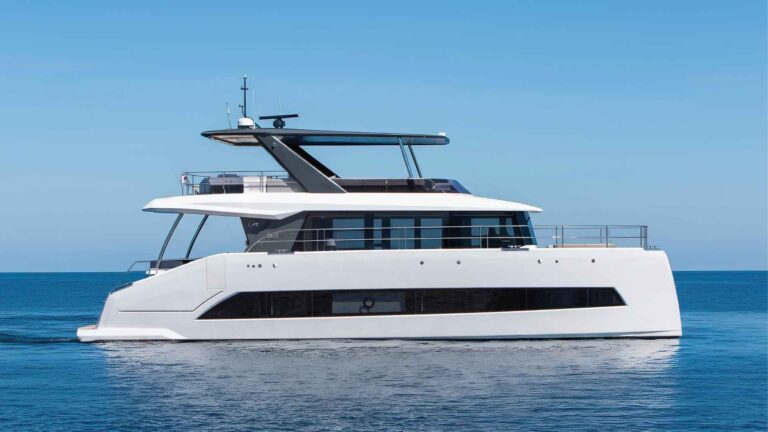
Rather than asking buyers to take chinese built yachts quality on faith, the OceanWalker S60's specification is verifiable componentry, not marketing language. Propulsion is 2 × Volvo Penta D6-440 diesel engines (880 hp combined) — Volvo Penta is a Swedish marine engine manufacturer with a global service and parts network, and it is the same engine brand fitted across a wide range of European-built production yachts. Navigation, chartplotting and helm electronics are Garmin, an established US marine electronics brand used industry-wide. Neither of those is a generic, unbranded Chinese component — both are internationally recognised marine brands that a buyer can independently verify, service and get spare parts for almost anywhere in the world.
The rest of the S60's build is equally specific rather than vague: LOA is 18.87 m (60 ft), beam is 8.38 m (27'6"), the layout is 4 en-suite guest cabins plus 2 crew cabins, flybridge area is 500+ sq ft, and the boat carries a 32 kW generator alongside an optional 22-panel, 9 kW solar array. Top speed is 18 knots with a cruising range of roughly 1,500 nm. The boat is priced at €3.2M with all options included and is available now as a Mediterranean demonstrator. Every one of these figures comes from the boat's own specification sheet, not from a generic "chinese built yachts quality" claim — and every figure is something a buyer can check in person at a private viewing of the OceanWalker S60 before committing to anything.
CE marking is frequently misunderstood in the chinese built yachts quality conversation, so it's worth being precise about what it actually is. CE marking under the EU's Recreational Craft Directive (RCD 2013/53/EU) is a mandatory regulatory requirement for any recreational boat placed on the market or put into use within the European Union, regardless of where it was designed or built. It confirms the boat has been assessed against harmonised EU standards covering structural integrity, stability, buoyancy, fire safety, exhaust emissions and electrical systems, and it is checked by an accredited notified body before the CE mark can legally be applied. It is not, on its own, a marketing claim of luxury or finish quality — it is a compliance floor every boat sold into the EU market must clear.
That distinction matters for chinese built yachts quality specifically: CE/RCD conformity is assessed against the boat itself, not against the nationality of the yard that built it. A Chinese-built yacht sold into the EU market has to clear the same harmonised safety and structural bar as a French-built or Italian-built yacht sold into that same market — there is no separate, lower standard for imported hulls. For any yacht under serious consideration, including the OceanWalker S60, a buyer's due-diligence checklist should include confirming CE/RCD conformity documentation directly with the seller, alongside the design category it's rated for, before signing anything.
The most useful response to a chinese built yachts quality concern isn't a slogan, it's a checklist — and it's the same checklist that applies to any yacht purchase, built anywhere. First, a private viewing: performance on the water under real load tells a buyer more about a specific hull than any brochure, and it's the fastest way to catch drivetrain, handling or systems issues early. Second, a hull and lamination inspection, ideally alongside a qualified independent marine surveyor, checking for print-through, void areas, moisture ingress and consistency of finish below the waterline as well as above it. Third, warranty terms in writing — what's covered, for how long, and who actually honours a claim if something goes wrong after delivery. Fourth, the pedigree of the engines and electronics actually fitted, which is exactly where the OceanWalker S60's Volvo Penta and Garmin componentry is a genuine, checkable answer rather than an assumption.
European Yacht Brokers builds every OceanWalker S60 sale around this same process: a private viewing, the option of an independent survey before any commitment, and clear warranty terms explained up front rather than buried in fine print. That's the honest way to settle a chinese built yachts quality question on any specific boat — not by trusting or distrusting a country of origin, but by putting the actual hull, the actual engines and the actual paperwork in front of an independent expert. Buyers who want a deeper look at what ownership actually costs once the purchase is made can review the OceanWalker S60 running costs guide as a companion piece to this one.
Resale perception is one of the more honest places to look at the chinese built yachts quality question, because buyers vote with their money. A decade ago, a Chinese-built yacht may have faced a heavier resale discount purely on assumption. That gap has been closing as more buyers do informed due diligence — checking the actual componentry, the actual survey report and the actual warranty history — rather than pricing a boat purely on where it was built. High-volume, well-distributed Chinese-built ranges with strong dealer networks now trade actively on the used market alongside European-built boats in the same size class, which is itself evidence that resale buyers increasingly judge chinese built yachts quality case by case.
For a newer model like the OceanWalker S60, there isn't yet a long resale track record to point to, and it would be dishonest to claim one. What is fair to say is that a fully-specced boat with recognised, serviceable componentry (Volvo Penta, Garmin), documented CE/RCD conformity and a clean survey history is exactly the profile that tends to hold resale value best, regardless of build origin — because those are the same factors a future buyer's own due diligence will check.
For readers researching chinese built yachts quality further, three independent sources are worth checking directly: the European Commission's own guidance page on CE marking and the Recreational Craft Directive, Volvo Penta's official D6 marine engine specification page, and Garmin's official marine electronics and navigation range.
Yachts sold into the EU market, including the OceanWalker S60, are required to meet CE marking under the EU's Recreational Craft Directive (RCD 2013/53/EU). Buyers should confirm the specific conformity documentation and design category directly with European Yacht Brokers before purchase, as with any yacht purchase in the EU.
The S60 runs 2 × Volvo Penta D6-440 diesel engines, 880 hp combined — a Swedish marine engine brand with a global parts and service network, not a generic Chinese-made engine.
Yes. European Yacht Brokers supports an independent marine survey and a private-viewing private viewing as a standard part of the OceanWalker S60 buying process, so build quality is verified directly rather than taken on trust.
It can, but the effect is shrinking. Resale perception around chinese built yachts quality is improving industry-wide as more buyers judge a boat on its actual componentry, survey history and warranty record rather than on country of origin alone.
No. Chinese-built yacht quality varies as much between individual yards as it does anywhere else in the world — the same is true of European and American yards. The relevant question is always which specific yard and which specific componentry, not the country alone.
The materials, standards and componentry are directly comparable: Volvo Penta engines, Garmin electronics and EU CE/RCD conformity for any boat sold into the EU market are the same regardless of where the hull was built. The build location is different; the verifiable standard it must meet to sell in Europe is not.
See the OceanWalker S60's build for yourself
The most honest answer to any chinese built yachts quality question is a private viewing and an independent survey — book a private viewing of the Mediterranean demonstrator now.
Book a Private Viewing