
Fast facts:
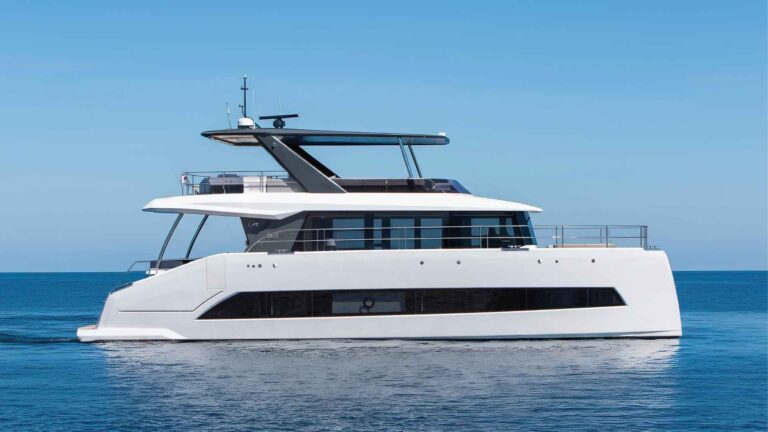
A flybridge, in plain terms, is an open deck built above the main cabin roof, usually carrying a second helm station and some form of seating. Plenty of monohull motor yachts have one. What makes a power catamaran flybridge different — and genuinely more useful — comes down to a simple fact of naval architecture: a catamaran's beam. The OceanWalker S60 is 8.38 m (27'6") wide, spread across two hulls rather than tapered to a single narrow deck, and that width carries straight up to the flybridge level. A monohull of the same 60 ft length has to narrow its upper deck to keep its center of gravity in check; the S60 doesn't face that trade-off, because its stability already comes from the two hulls below, not from keeping weight low and narrow up top.
The practical result isn't a strip of deck with a helm chair bolted to it — it's a genuine second living space, wide enough for real furniture and real numbers of people at once. On a sailing catamaran, that same deck usually shares space with a mast, boom, traveler and running rigging, eating into usable area and adding hazards to step around. A power catamaran flybridge carries none of that: no rig, no boom overhead, just open deck, built for entertaining and helming. That's the real differentiator buyers weigh against a monohull's cramped upper deck or a sailing cat's rig-crowded one: whether the boat actually has room for everyone to be outside, together, at once.
The S60's flybridge measures over 500 square feet — a figure taken directly from the boat's own specification sheet, not a rounded-up brochure estimate. It's worth sitting with for a moment: 500 square feet is close to the footprint of a decent-sized studio apartment, entirely outdoors, one deck above the saloon. In practical terms, that space is laid out around a forward helm station with full sightlines over the bow, and an aft lounging and entertaining area under the hardtop, giving guests a place to sit, eat and socialise separate from wherever the boat is actually being driven from.
Shade is a genuine consideration on any flybridge, and the S60 addresses it with a hardtop rather than leaving owners to bolt on an aftermarket bimini after delivery. That hardtop does double duty: it's also where the optional 22-panel, 9 kW solar array is mounted, across the hardtop and flybridge roof, capturing the most unobstructed sun of anywhere on the boat through the middle of the day. That's a confirmed fact about the S60's build, not a general inference — the panels sit exactly where a power catamaran flybridge naturally has the most open, sun-exposed real estate available. What's honestly a matter of layout preference rather than a fixed number is exactly how many guests the aft area seats comfortably; European Yacht Brokers can walk a buyer through the current furniture configuration during a private viewing of the demonstrator, since that's the kind of detail better seen than described.
A power catamaran flybridge earns its keep at anchor, not underway, and the Mediterranean is close to the ideal setting for that. Picture the boat swinging on the hook off Cannes as the sun drops toward the Esterel hills, guests up top with drinks in hand, the saloon below left quiet and cool. That's not a scenario invented for this page — it's the specific, repeatable use case the flybridge is built around, and it's the kind of evening this site's Cannes listing page describes for owners berthed along that coast.
The same logic holds wherever the S60 spends a season. Its flybridge is equally at home for sundowners in a quiet Corfu anchorage as it is hosting an afternoon of entertaining off Palma, because the deck doesn't change — only the view does. That's part of why a power catamaran flybridge matters more here than on a boat built for colder, choppier waters: the Mediterranean's long, calm, high-sun season is exactly the window in which the space gets used almost daily rather than sitting empty. Owners chartering the S60 report the same pattern this site's marina pages describe for guests generally — the flybridge, not the saloon, is where most of the living happens once the anchor's down.
Every flybridge has to answer two practical questions before it's a genuine living space rather than a photo opportunity: how do you get up there, and what happens when it rains. On the S60, access is via a dedicated stairway rather than a fold-down ladder, which matters more than it sounds — a proper stairway means the deck is realistically usable by guests of any age or mobility level, carrying drinks or plates up and down without it feeling like a climbing exercise. That's a meaningful difference from smaller boats in this class, where a steep ladder can quietly rule out the flybridge for anyone who isn't confident on their feet at sea.
Weather protection is where the hardtop earns its place. A power catamaran flybridge without permanent shade is a fair-weather-only space, useful for maybe half a season and abandoned the rest. The S60's hardtop keeps the helm station and lounging area shaded and largely rain-protected without a canvas enclosure to zip on and off. It won't turn the space into an all-weather room the way an enclosed saloon is, and it shouldn't be sold as one — but for the settled, high-sun Mediterranean conditions the S60 is built for, it's enough protection to make the flybridge usable most days a season actually offers.
Every genuine benefit on a boat comes with a trade-off, and a power catamaran flybridge is no exception. Stacking a full second deck above the saloon raises the boat's overall profile and its air draft — the vertical distance from the waterline to the highest fixed point, whether that's hardtop, antenna or radar arch. A taller air draft is the one place the flybridge can matter beyond the anchorage: some Mediterranean routes involve fixed bridges or low-clearance passages, chiefly on inland or lagoon-adjacent waterways rather than open coastal cruising, where a boat's exact air draft needs checking against the charted clearance before committing to a route.
To be straightforward about what is and isn't confirmed: the S60's specification sheet doesn't publish a single stated air-draft figure, so this page won't invent one. What can be said honestly is that any boat carrying a full-size flybridge and hardtop sits taller overall than an equivalent boat without one — a genuine planning consideration, not a deal-breaker, since most Mediterranean coastal cruising and marina berthing the S60 is built for involves open water and standard infrastructure, not low fixed bridges. For any specific passage where air draft is a real question, European Yacht Brokers can confirm the boat's exact measured height as part of route planning.
Unlike the solar array or other options on the order sheet, the flybridge itself isn't an add-on choice on the S60 — it's part of the boat's core layout, standard on every hull, over 500 square feet of it included in the €3.2M price with all options. That matters for how a buyer should think about the number: it isn't a line item competing against other upgrades, it's a structural part of what the S60 is, in the same way the 4 en-suite guest cabins or the twin Volvo Penta D6-440 engines are standard rather than optional.
On stability and handling, a power catamaran flybridge sits on a hull form already engineered to carry it. The S60's stability comes from its beam and twin-hull buoyancy, not from keeping weight low the way a narrow monohull has to, so a full-size flybridge doesn't compromise handling the way stacking similar weight onto a monohull's narrower platform would. That's why a flybridge this size is a comfortable feature on the S60 rather than a design risk: the platform underneath was built with the extra deck already accounted for. For buyers weighing this against a competing monohull or sailing cat, that's the honest engineering answer — see the OceanWalker S60 page for the full specification the flybridge sits on top of.
For readers researching flybridge design and cruising practicalities further, three independent sources are worth checking directly: Yachting Magazine's report on rising power catamaran popularity and how owners are actually using flybridge-equipped boats, Catamaran Guru's independent look at modern catamaran design trends, including the flybridge trend specifically, and Makai Yachts' plain-English explainer on air draft and bridge clearance for context on the profile trade-off discussed above.
Over 500 square feet — a figure taken directly from the boat's own specification sheet. That makes the S60's power catamaran flybridge one of the largest single outdoor living spaces on a 60 ft yacht in this class, roughly the footprint of a small apartment, entirely above the saloon.
Yes — the aft lounging and entertaining area under the hardtop is built for exactly that, seating and shade included. It's a genuine second living space for meals and entertaining, not just a helm perch, which is the whole point of a power catamaran flybridge this size.
No in any meaningful way. The S60's stability comes from its beam and twin-hull buoyancy rather than from keeping weight low and narrow, so the hull form underneath the power catamaran flybridge was engineered to carry it, not retrofitted around it afterward.
Standard. Unlike the solar array or other order-sheet options, the power catamaran flybridge is part of the S60's core layout on every hull, included in the €3.2M price with all options rather than sold as an add-on.
Yes, honestly — stacking a full-size power catamaran flybridge and hardtop raises the boat's overall profile compared with an equivalent boat without one. The S60's spec sheet doesn't publish a single stated air-draft figure, so buyers with a specific low-bridge route in mind should confirm the exact measured height with European Yacht Brokers directly.
Partially. The hardtop keeps the helm station and main lounging area shaded and largely rain-protected without a canvas enclosure, which covers the great majority of settled Mediterranean cruising days, though it isn't a fully enclosed, all-weather room the way the saloon below is.
See the S60's flybridge for yourself
Over 500 square feet of outdoor living, standard on every hull — book a private viewing of the Mediterranean demonstrator and walk the flybridge in person.
View the OceanWalker S60